Category: Automotive

  • From Space to Earth: Electra Recognized by NASA Spinoff for Battery Intelligence

    Electra, the leading AI-driven battery intelligence company, today announced its recognition by NASA Spinoff.

    BOSTON, MA, UNITED STATES, February 4, 2026 /EINPresswire.com/ — Electra, the leading AI-driven battery intelligence company, today announced its recognition by NASA Spinoff, the official NASA program highlighting technologies originally developed for space missions and successfully transferred to impactful real-world applications.

    The recognition comes through the NASA Spinoff feature “Knowledge Is Battery Power,” which showcases how software and analytical approaches developed for space exploration are now improving battery performance, safety, and longevity across electric mobility and energy storage applications on Earth.

    👉 Read the full NASA Spinoff feature, “Knowledge Is Battery Power,” here: https://spinoff.nasa.gov/Knowledge_Is_Battery_Power
    👉 Check out the video announcement: https://youtu.be/z-WZeIN0G5M?si=SLbAU41-e01l8ubM

    From Space Missions to Terrestrial Impact
    Electra’s technological foundations trace back to work conducted alongside NASA’s Goddard Space Flight Center, where advanced software was developed to monitor, model, and manage power systems for high-altitude balloons and planetary rovers. These missions operate in extreme, mission-critical environments, where system failure is not an option and real-time understanding of battery behavior is essential.
    In that context, batteries could not be treated as passive components. They required continuous monitoring, predictive insight, and intelligent software capable of anticipating degradation, failure modes, and performance limits under extreme constraints.

    This space-born approach to battery intelligence — grounded in physics-based modeling, advanced analytics, and real-time decision-making — became the foundation of what would later evolve into Electra.

    A Software-First Vision for Batteries
    Electra was built on a core belief shaped by those early NASA collaborations: batteries are not just hardware, but intelligent systems. Their full value is unlocked not only through chemistry and design, but through software capable of interpreting data, learning behavior over time, and enabling proactive control. The knowledge and software developed for space missions were adapted and expanded to address the challenges of electric vehicles, fleets, and energy storage systems on Earth — where reliability, safety, cost efficiency, and lifetime optimization are equally mission-critical.

    Today, Electra’s AI-driven battery intelligence platform gives manufacturers, operators, and energy stakeholders deep visibility into battery health and performance, enabling accurate lifetime prediction, reduced operational risk, and maximized value across energy assets. In practice, Electra delivers an AI-driven Battery Management System (AI-BMS).

    Building on a Space-Grade Legacy
    For Electra’s leadership team, the NASA Spinoff recognition reflects the company’s DNA.

    “Our work with NASA taught us that when failure is not an option, intelligence becomes essential,” said Fabrizio Martini, Co-Founder and CEO of Electra. “In space, you cannot rely on guesswork. You need deep knowledge, predictive insight, and software that can anticipate how systems will behave over time. Electra was built on that principle, and we’ve carried it forward into everything we do.”

    “Being featured by NASA Spinoff is a strong validation of Electra’s technological origins and long-term vision,” said Giovanni Rossi, Head of Marketing and Communications at Electra. “Our approach to battery intelligence was shaped by space exploration, where reliability, prediction, and performance are non-negotiable. Today, we apply that same space-grade discipline to electric mobility and energy systems on Earth, helping our partners unlock higher performance, greater reliability, and lasting value across the battery lifecycle.”

    Powering the Energy Transition
    As batteries become central to the global energy transition, AI-driven intelligence will define their impact.
    Electra’s NASA-born approach brings space-grade analytics and AI to the heart of energy and mobility systems, transforming data into actionable insight and enabling safer, longer-lasting, and more efficient batteries.

    NASA Spinoff recognition reinforces Electra’s journey from space research to real-world application — demonstrating how innovation designed for exploration can help shape a more sustainable energy future on Earth.

    ___________
    About Electra
    Electra Vehicles is the leading AI-driven cleantech and B2B software company unlocking the full potential of battery technology. By combining Agentic AI and Physical AI, Electra delivers end-to-end intelligence across the battery lifecycle—fusing advanced AI/ML software with real-world battery systems to create the AI-Brain for batteries, an AI-BMS that enables batteries to sense, reason, and act.

    Electra powers the next generation of energy operators—from grid-scale storage and renewables to data centers and battery manufacturers—as well as e-mobility leaders, including automotive OEMs, Tier 1 suppliers, and fleet operators, and the emerging wave of robotics and autonomous systems, enabling a cleaner, more resilient, and fully electrified energy future.

    Giovanni Rossi
    Electra Vehicles
    +1 617-741-8736
    email us here

    From Space to Earth: Electra Recognized by NASA Spinoff for Battery Intelligence

    Legal Disclaimer:

    EIN Presswire provides this news content “as is” without warranty of any kind. We do not accept any responsibility or liability
    for the accuracy, content, images, videos, licenses, completeness, legality, or reliability of the information contained in this
    article. If you have any complaints or copyright issues related to this article, kindly contact the author above.


  • Lobster Data Launches in North America to Tackle Supply Chain Data Chaos

    European data integration specialist expands to North America with Bosch collaboration, targeting logistics providers and supply chain operators.

    “This is about solving real problems – slow supplier onboarding and limited visibility. Bosch gives us the platform and enterprise infrastructure to bring our technology where businesses need it most.”
    — Tim Srock, CEO of Lobster Data

    MUNICH, BAVARIA, GERMANY, February 4, 2026 /EINPresswire.com/ — Lobster Data Launches in North America to Tackle Supply Chain Data Chaos

    Lobster Data, a leading provider of data integration solutions for supply chain across logistics, manufacturing, and retail, today announced its expansion into North America to help companies tackle supply chain data chaos and fragmented systems. Building on its success serving more than 2,000 customers across Europe, Lobster is bringing its proven data integration platform to North American businesses struggling with slow supplier onboarding, limited visibility, and disconnected supply chain operations.

    To deliver this technology with local support and infrastructure, Lobster has entered into a strategic collaboration with Bosch Mobility Platform & Solutions LLC, which will serve as a value-added reseller across the United States. The collaboration combines Lobster’s data integration platform with Bosch L.OS – Bosch’s Logistics Operating System – creating a solution for logistics service providers and fleet operators struggling with fragmented systems, slow supplier and carrier onboarding, and limited supply chain visibility.

    According to the Council of Supply Chain Management Professionals, U.S. business logistics costs reached $2.58 trillion in 2024, with inefficient integration processes adding weeks or months to onboarding timelines and limiting real-time visibility across operations. Together, the two companies are addressing this critical challenge: enabling logistics providers to connect seamlessly with customers, partners, and trading networks while maintaining the security and scalability that enterprise operations demand.

    Bosch will provide comprehensive support across the United States, including local hosting, implementation services, sales and customer support tailored to the North American market. This localized approach ensures that customers receive the responsive service and data residency they need while benefiting from Lobster’s advanced integration technology.

    “This agreement is about more than expanding our footprint,” said Tim Srock, CEO of Lobster Data. “It’s about delivering real value to logistics providers and supply chain operators who are tired of waiting months to onboard a new customer or carrier or struggling to get visibility across their networks. Working with Bosch gives us the platform and reach to bring our technology to businesses that need it most, backed by the kind of enterprise support and infrastructure that only a company like Bosch can provide.”

    The collaboration helps to advance both companies’ strategic goals. For Bosch, it strengthens L.OS as a platform ecosystem where independent software vendors can scale globally. For logistics providers, the integration delivers faster, more efficient connectivity across supply chain operations, from onboarding customers and carriers to automating procure-to-pay and order-to-cash processes to gaining real-time visibility across transportation and warehouse operations.

    “We chose to work with Lobster because they bring deep technical expertise in logistics and supply chain integration, with a platform that has proven itself in demanding enterprise environments,” said Luke Hugel, president, Bosch Mobility Platform & Solutions LLC. “With over 20 years of experience and more than 2,000 customers, Lobster has demonstrated the reliability our logistics market needs. This collaboration allows us to offer our customers a complete solution: best-in-class data integration combined with security and scalability of Bosch’s global infrastructure. Together, we’re making it easier for logistics providers to connect their systems, work with their partners, and respond to market changes with confidence.”

    The agreement targets enterprise and mid-market logistics service providers, as well as manufacturers and retailers with complex supply chain operations. While the initial focus is on the United States, both companies are exploring expansion opportunities in Canada and Europe. Bosch will manage all customer-facing operations in North America, including sales, account management, consulting, project delivery, and first-line support, while Lobster provides specialized technical expertise and ongoing platform development. Both companies will showcase the integrated solution at Manifest in Las Vegas this February and at Bosch ConnectedWorld 2026 in Berlin this June.

    About Lobster

    Lobster Data GmbH is a leading provider of data integration solutions for supply chain across logistics, manufacturing, and retail. Founded in Germany with over 20 years of experience, Lobster serves more than 2,000 customers across Europe. The Lobster Data Platform unifies systems, partners, and data in real time, eliminating manual work and breaking down data silos to deliver measurable ROI in weeks rather than months. With no-code orchestration and purpose-built supply chain integration capabilities, Lobster helps organizations connect their systems and automate workflows without replacing existing infrastructure.

    For more information, visit www.lobster-world.com

    Patryk Statkiewicz
    Lobster Data
    +31 6 58816394
    patryk.statkiewicz@lobster.de
    Visit us on social media:
    LinkedIn
    YouTube

    Legal Disclaimer:

    EIN Presswire provides this news content “as is” without warranty of any kind. We do not accept any responsibility or liability
    for the accuracy, content, images, videos, licenses, completeness, legality, or reliability of the information contained in this
    article. If you have any complaints or copyright issues related to this article, kindly contact the author above.

  • L-Charge Launches Mobile EV Charging & Roadside Assistance Vehicle: High-Power Mobile Charging On-the-Go

    L-Charge launches Mobile EV Charging Vehicle, one of the highest-powered mobile EV chargers on the market designed specifically for fleet and tow operators.

    This vehicle was built to solve a need in the market for mobile EV charging, it’s a service truck first – with high-power EV charging integrated in a way that doesn’t compromise space or safety.”
    — Stephen Kelley, CEO, L-Charge

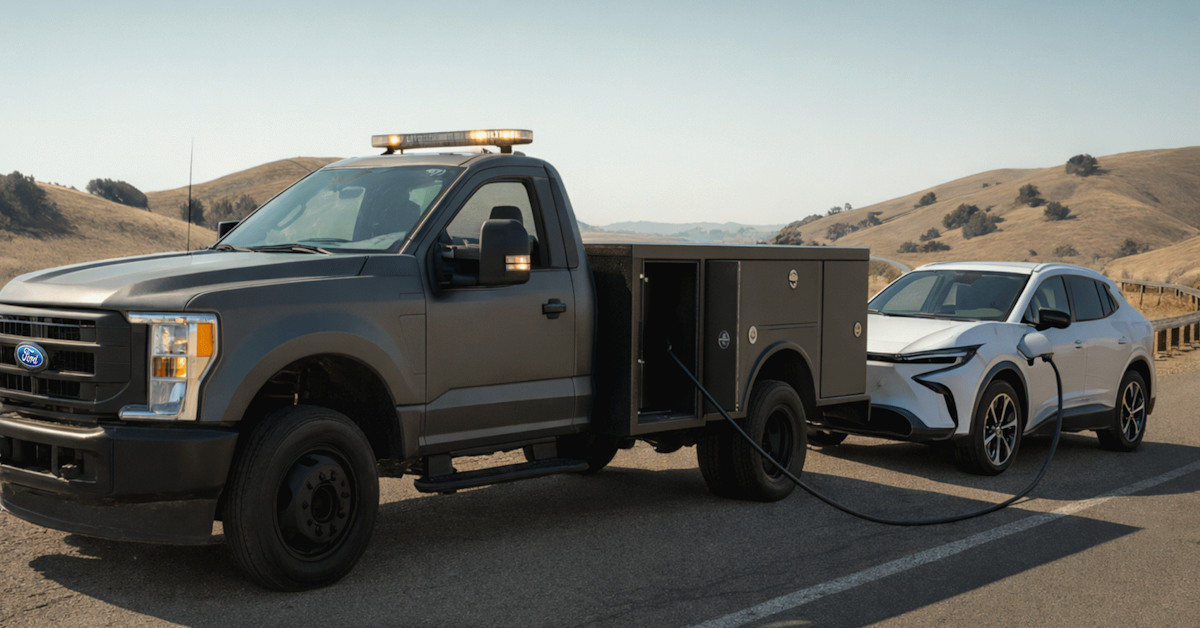
    REDWOOD CITY, CA, UNITED STATES, February 4, 2026 /EINPresswire.com/ — L-Charge today announced the launch of its Mobile EV Charging & Roadside Assistance Vehicle, one of the highest-powered mobile EV chargers on the market designed specifically for tow and fleet operations.

    The Mobile EV Charging & Roadside Assistance Vehicle was developed to deliver high-power charging wherever fleets need it most – supporting sites with limited infrastructure, rescuing EVs that have run out of charge, and enabling roadside repair and fast charging in a single service vehicle. The platform also opens new use cases for towing, roadside assistance operators and fleets that need mobile charging.
    The vehicle combines a full-featured fleet service truck with integrated 60 kW DC fast charging, adding 35–50 miles of range in approximately 10 minutes and enabling up to 15 hours of continuous charging using the onboard power take-off (PTO).

    Why L-Charge Built This Vehicle

    The Mobile EV Charging & Roadside Assistance Vehicle was designed for operators who need flexibility, uptime, and speed as electric fleets scale. Many electric vehicles are damaged during towing and cost fleet operators tens of thousands of dollars each month. Traditional mobile chargers often rely on large batteries or generators that consume the entire truck bed, eliminating space for tools and service equipment. L-Charge engineered the smallest 60 kW mobile DC fast charger on the market, allowing full use of the truck bed and storage compartments for everyday fleet and roadside operations.

    “This vehicle was built to solve a need in the market for true mobile charging,” said Stephen Kelley, CEO of L-Charge. “It’s a service truck first – with high-power EV charging integrated in a way that doesn’t compromise space, safety, or productivity.”

    A Fleet Service Vehicle First – With Fast Charging Built In

    Unlike conventional mobile charging solutions, the L-Charge Mobile EV Charging & Roadside Assistance Vehicle retains all the capabilities operators expect from a modern service truck, including:

    – Air compressor and tire service
    – Fluid storage and top-off
    – Service crane and lift gate
    – Tool storage and standard towing
    – ICE and EV support
    – These are the same vehicles fleet owners, municipalities, and towing operators purchase today – now enhanced with high-power mobile EV charging.

    Fast, PTO-Powered Charging – No Batteries, No Grid Dependency

    Charging power is delivered via a power take-off (PTO) system, running directly off the truck’s engine and existing fuel supply. This architecture eliminates onboard batteries or additional fuel tanks, enabling continuous operation and up to 15 hours of fast charging anywhere it’s needed.
    The system can add 35-50 miles of range in approximately 10 minutes, reducing roadside service time, improving driver safety, and minimizing operational disruption.

    No CDL Required, No Trailer to Tow

    Many mobile charging trailers exceed 10,000 lbs, requiring a tow vehicle and a commercial driver’s license (CDL). The L-Charge Mobile EV Charging & Roadside Assistance Vehicle avoids this complexity entirely.
    Operators get a single, self-contained service vehicle with integrated 60 kW DC fast charging, no CDL requirement, and no trailer to tow, store, or manage – simplifying dispatch, staffing, and daily operations.

    Target Markets and Use Cases

    The Mobile EV Charging & Roadside Assistance Vehicle was developed for multiple growing markets, including:
    – Towing and roadside assistance operators seeking faster charge times, safer roadside operations, and new revenue streams from EV charging services
    – Cities and counties transitioning from ICE fleets and seeking mobile charging solutions during infrastructure build-out and traditional service vehicles
    – Fleet owners who need to rescue EVs that have run out of charge and maintain uptime
    – Fleet operators looking for a cost-effective alternative to permanent fast-charging infrastructure – where installing 60 kW of fixed charging can exceed $100,000
    The vehicle can also serve as a mobile fast charger for daily fleet operations, bringing charging directly to vehicles whenever and wherever it’s needed.
    Built in California. Available Through Sourcewell.

    About L-Charge

    L-Charge expands access to electric vehicle charging through off-grid solutions that remove utility and site constraints. By delivering fast, modular, and fully managed power and charging services, L-Charge enables commercial fleets to deploy EV infrastructure quickly, scale with demand, and stay operational wherever power is needed.
    For more information, visit www.l-charge.net.

    Julia Fedorova
    L-Charge
    +1 669-322-1920
    email us here
    Visit us on social media:
    LinkedIn
    YouTube

    Legal Disclaimer:

    EIN Presswire provides this news content “as is” without warranty of any kind. We do not accept any responsibility or liability
    for the accuracy, content, images, videos, licenses, completeness, legality, or reliability of the information contained in this
    article. If you have any complaints or copyright issues related to this article, kindly contact the author above.
  • Innovative Designs by Top Precision Drawn Parts Manufacturer Revolutionize Industrial Production

    CANGZHOU CITY, HEBEI PROVINCE, CHINA, February 4, 2026 /EINPresswire.com/ — Over the past decade, manufacturing industries worldwide have moved steadily toward higher precision, tighter tolerances, and more demanding material specifications. Whether the end product is a component inside a commercial aircraft, an implant used in surgery, or a part inside an electric vehicle, the standard for quality has risen sharply. Keeping pace with these changes requires more than just upgraded machinery — it demands a rethinking of how parts are designed, engineered, and produced from the ground up.

    Cangzhou Mengqi Hardware Products Co., Ltd., a precision parts manufacturer based in Cangzhou, Hebei Province, China, is one of the companies that has taken this approach seriously. With a focus on both metal stamping and CNC machining, the company has built a reputation for delivering components that meet the specifications set by customers in aerospace, automotive, electronics, and other sectors. Their work reflects a broader industry trend: that design and process innovation, not just raw manufacturing capacity, are what separate reliable suppliers from the rest.

    This article looks at how these design-driven changes are reshaping precision parts manufacturing, and why the shifts happening now have real consequences for industrial production worldwide.

    1. The Shift Toward Precision in Modern Manufacturing

    The push toward precision in manufacturing is not new, but its pace has accelerated in recent years. A key reason is the increasing complexity of end-use products. Modern electric vehicles, for example, contain thousands of metal components that must fit together with very little margin for error. Similarly, aerospace manufacturers are under pressure to reduce the weight of aircraft while maintaining structural integrity, which means every part must be engineered to exact specifications.

    According to a 2023 report by Grand View Research, the global precision machining market was valued at approximately $3.2 billion and is projected to grow at a compound annual growth rate (CAGR) of around 5.8% through 2030. The metal stamping market, which serves a broader range of industries, is even larger — estimated at over $15 billion globally — and is also seeing steady growth driven by demand in automotive and consumer electronics.

    These numbers reflect a simple reality: as products become more sophisticated, the parts that go into them must be made with greater care and accuracy. Manufacturers who can consistently deliver that level of quality are in a strong position.

    2. Why Design Matters as Much as Equipment

    For a long time, the conversation around manufacturing quality focused primarily on equipment — the precision of the machines, the speed of the production line, and the materials used. That conversation has shifted. Industry experts and engineers increasingly point to the design phase as one of the most critical stages in producing reliable precision parts.

    Design for Manufacturability (DFM) is a process in which engineers work backward from the final part specifications to determine the most efficient and accurate way to produce it. This involves considering factors like material selection, tool paths, draft angles, and surface finish requirements before a single cut is made. When DFM is done well, it reduces waste, lowers the rate of defective parts, and shortens production timelines.

    Computer-aided design (CAD) and computer-aided manufacturing (CAM) software have made this process faster and more precise than ever. Advanced simulation tools allow engineers to test designs digitally, identifying potential problems — such as stress points or dimensional drift — before physical production begins. This combination of design thinking and digital tooling is what gives leading manufacturers a clear advantage in delivering parts that perform as expected.

    3. How Innovation in Stamping and Machining Addresses Real Challenges

    Precision stamping and CNC machining are two of the most widely used processes for producing metal components at scale. Each has its strengths, and each has seen meaningful improvements in recent years — both in terms of equipment capability and in how parts are designed for these processes.

    Metal stamping, for instance, is well suited for producing large volumes of identical parts with consistent dimensions. Advances in progressive die design and servo-driven presses have allowed manufacturers to hold tighter tolerances while maintaining high output. For customers in the automotive and electronics industries, this translates directly into parts that fit better and last longer.

    CNC machining, on the other hand, excels at producing complex geometries with very high precision. Multi-axis machining centers — machines that can cut from five or more directions — have become more affordable and capable over the past several years. This has opened the door for manufacturers to take on more intricate parts that would have been difficult or too costly to produce just a decade ago.

    Cangzhou Mengqi Hardware Products Co., Ltd. has invested in both of these areas, applying updated design methodologies alongside modern equipment to produce parts that meet the specifications demanded by its customers. The company’s approach illustrates a point that many in the industry are coming to recognize: that consistent quality comes from the combination of good design and capable manufacturing, not from either one alone.

    4. Precision Metal Stamping Parts: Consistency and Efficiency at Volume

    One of the clearest examples of how design innovation has changed manufacturing output is in the area of Precision Metal Stamping Parts. Stamping has long been a go-to process for high-volume production, used heavily in automotive body panels, electrical connectors, brackets, and housings. The challenge has always been maintaining dimensional accuracy across thousands — or millions — of parts.

    Recent improvements in die design, combined with better quality steel and more precise press alignment, have made it possible to stamp parts with tolerances as tight as ±0.01 mm in some applications. This level of consistency is critical for components that must mate with other precision parts in an assembly. When tolerances are met reliably, assembly time goes down, scrap rates drop, and the overall cost per part decreases.

    For industries like automotive and consumer electronics, where production volumes are high and margins are thin, this kind of reliability is not optional — it is a basic requirement for staying competitive.

    5. Precision CNC Machined Parts: Handling Complexity Without Compromise

    While stamping handles volume well, there are many applications where the geometry of a part is too complex for a stamping die. This is where Precision CNC Machined Parts come into play. CNC machining allows manufacturers to produce parts with intricate features — deep holes, angled surfaces, irregular profiles — from a single block of material, with very little human intervention during the cutting process.

    The aerospace and medical device industries are among the heaviest users of CNC machining. In aerospace, components like turbine housings and structural brackets often require tight tolerances and specific surface finishes that only machining can reliably deliver. In the medical field, implants and surgical instruments must be produced to exact dimensions, and even small deviations can have serious consequences.

    Five-axis and six-axis CNC machines have become standard in many precision shops. These machines reduce setup time by allowing multiple operations to be completed in a single setup, which improves both speed and accuracy. The result is a manufacturing process that can handle complex parts without a significant increase in lead time or cost.

    6. Quality Control and Industry Standards

    Producing precise parts is one thing; proving that they meet specifications is another. Quality control in precision manufacturing relies on a combination of in-process checks and final inspection.

    Coordinate Measuring Machines (CMMs) are the standard tool for verifying the dimensions of machined and stamped parts. These machines can measure features down to the micrometer level, providing objective data on whether a part meets its drawing tolerances. Many precision manufacturers also use optical inspection systems and surface roughness testers to check for surface defects and finish quality.

    ISO 9001 and IATF 16949 are two of the most common quality management standards followed by manufacturers in this space. ISO 9001 provides a general framework for quality systems, while IATF 16949 is specific to the automotive supply chain and includes additional requirements around risk management and process control. Manufacturers that hold these certifications have demonstrated that their quality systems are structured, documented, and regularly audited.

    7. Looking Ahead: Where Precision Manufacturing Is Headed

    The trends shaping precision manufacturing over the next five to ten years are already visible. Automation and machine learning are being integrated into production lines to reduce human error and improve output consistency. Digital twins — virtual replicas of physical machines and processes — are allowing manufacturers to monitor and optimize production in real time.

    Sustainability is also becoming a factor. Customers and regulators alike are paying more attention to material waste, energy consumption, and the environmental impact of manufacturing. Processes that minimize scrap and use energy efficiently are gaining ground, and manufacturers who can demonstrate this capability are likely to see increasing demand.

    Finally, supply chain resilience remains a priority for many industries following the disruptions of the past few years. Manufacturers that can offer reliable quality, reasonable lead times, and transparent communication are in a strong position to secure long-term contracts.

    For precision parts manufacturers that have already invested in design innovation, advanced equipment, and rigorous quality systems, these trends represent opportunities rather than obstacles. The companies that have built their processes around accuracy and consistency are well placed to meet the demands of the next decade.

    8. About Cangzhou Mengqi Hardware Products Co., Ltd.

    Cangzhou Mengqi Hardware Products Co., Ltd. is a precision hardware manufacturer based in Cangzhou, Hebei Province, China. The company specializes in the design and production of metal stamping parts, CNC machined parts, and other precision components for customers across a range of industries, including automotive, aerospace, electronics, and machinery. With a focus on quality control, technical capability, and customer service, Cangzhou Mengqi has built a track record as a reliable supplier for both domestic and international markets. The company operates modern manufacturing facilities equipped with advanced stamping presses, multi-axis CNC machines, and precision inspection equipment, and holds relevant ISO quality certifications.

    Address: Wumaying Village Development Zone, Nanpi County, Cangzhou City, Hebei Province
    Official Website: www.stampedpart.com

    Jia Yichao
    Cangzhou Mengqi Hardware Products Co., Ltd.
    sales@czmengqi.com

    Legal Disclaimer:

    EIN Presswire provides this news content “as is” without warranty of any kind. We do not accept any responsibility or liability
    for the accuracy, content, images, videos, licenses, completeness, legality, or reliability of the information contained in this
    article. If you have any complaints or copyright issues related to this article, kindly contact the author above.

  • KPIT launches Vehicle Relationship Management (VRM) solution on Salesforce’s scalable, secure & AI-powered CRM platform

    DETROIT, MI, UNITED STATES, February 4, 2026 /EINPresswire.com/ — KPIT Technologies, a global leader in mobility technology solutions, announced a strategic Outsourcing Service Provider (OSP) partnership with Salesforce, the world’s #1 AI CRM platform. This collaboration will enable KPIT to deploy its innovative and proven Vehicle Relationship Management (VRM) solution on Salesforce’s scalable, secure, and AI-powered CRM platform, driving measurable business outcomes for global automotive OEMs and mobility providers.

    Addressing the Industry Challenges

    The passenger car, trucks and off-highway industries are all being challenged to find ways in aftersales to provide exceptional customer experiences, maximize revenues, and manage global costs.

    This challenge of aftersales transformation comes at a time of ever more demanding vehicle complexity, increase in warranty cost, reduction in skilled labor, tighter regulations, and a multitude of fragmented aftersales systems.

    KPIT’s Vehicle Relationship Management (VRM), offers an integrated ecosystem that leverages customer data, vehicle data and AI to streamline the entire aftersales journey for both customers and vehicle manufacturers. This journey begins from vehicle sale with monitoring, software updates and intelligent maintenance. If there is a vehicle failure, pre-diagnosis, intelligent resource planning and workshop automation ensures that the vehicle is repaired quickly and efficiently.

    What is the partnership differentiator?

    KPIT brings over two decades of global domain expertise in automotive and helping OEMs reduce warranty claims up to ~10% reducing downtime for customers up to ~25% and increasing the dealership throughput up to ~20%. Now, KPIT brings its complete Vehicle Relationship Management (VRM), solution on Salesforce’s Agentforce 360 for Automotive to customers, featuring core modules such as the Data Platform, Triage module, Resource Module, Scheduling & Service Broker, Aftersales Information Bus, Customer Diagnostics Assistant, Predictive Maintenance and Remote Diagnostics, which are designed to address after-sales challenges and enable seamless, data-driven services for the automotive OEMs.

    Through the OSP partnership with Salesforce, KPIT customers gain a transformative advantage—greater cost control, accelerated innovation, enhanced flexibility, and access to Salesforce expertise delivered through managed, outcome-driven solutions.

    Salesforce’s Agentforce 360 for Automotive is a purpose-built AI CRM platform designed for OEMs, dealers, and captives. It unites driver and vehicle data to provide a unified platform for sales, service, finance, and in-vehicle customer interactions and layers powerful agentic AI on top so automotive companies can deliver deeply immersive, personalized experiences to their customers. This enables the delivery of immersive, personalized AI-powered experiences. For example, Connected Vehicle helps automotive companies unlock new revenue streams by deploying innovative subscriptions and services at scale. It brings vehicle telematics and driver data directly into the CRM, allowing for the creation of personalized, data-driven experiences. This unified platform accelerates innovation and time to market by turning rich data into valuable, monetizable customer offers.

    KPIT and Salesforce have been transforming the global aftersales ecosystem and empowering automotive OEMs to deliver enhanced customer experiences, improved operational efficiency, reduced vehicle downtime, and new revenue opportunities from aftermarket services. This collaboration sets a new benchmark for digital transformation in automotive after-sales, benefiting OEMs, dealers, and end customers alike.

    Kishor Patil, MD & CEO, KPIT Technologies said, “This partnership with Salesforce is an important moment in our endeavor to re-imagine mobility and the future of automotive aftersales. By combining KPIT’s VRM platform and decades of deep automotive domain expertise with Salesforce’s world-class AI-powered platform, we are going to empower mobility & automotive organizations to deliver seamless, proactive, and data-driven aftersales experiences. We will achieve this by deploying our in-production workflow solutions on Salesforce. We will also be building new end to end agentic AI based workflows together with Salesforce. Together, we want to set a new benchmark for operational efficiency, customer satisfaction, and innovation in the global mobility ecosystem.”

    Arundhati Bhattacharya, CEO & President, Salesforce South Asia, said, “The future of mobility is centered on delivering intelligent and seamless experiences, not just modern vehicles. Our partnership with KPIT combines the scale and intelligence of the Salesforce platform with KPIT’s forward-thinking approach to automotive solutions. We are powering the industry to deliver ‘vehicle-maintenance-as-a-service’ at scale for modern enterprises. This is about transforming a traditionally complex process into a proactive, customer-centric experience, and Salesforce is thrilled to be the technology platform that helps make KPIT’s vision a reality for modern automakers.”

    About KPIT Technologies:

    KPIT is reimagining the future of mobility, forging ahead with group companies and partners to shape a world that is cleaner, smarter, and safer.

    With over 25 years of specialized expertise in Mobility, KPIT is accelerating the transformation towards Software and AI-Defined Vehicles through its advanced solutions, platforms, and products—propelled by mobility-infused AI frameworks, software craftsmanship, and systems integration mastery.

    Vision in Motion

    Fueled by 2000+ vehicle production programs and powering 20+ million vehicles on the road with KPIT software, our experience is unmatched. At the same time, we push boundaries, developing solutions that enable Mobility OEMs to innovate at speed and scale.

    For more details visit www.kpit.com

    For media inquiries, please contact:

    KPIT Technologies:

    Mohit Kochar
    Chief Marketing Officer | mohit.kochar@kpit.com

    Sunil Ravish
    Sr. Director, Marketing | Media Relations | sunil.r@kpit.com

    Investor relations

    Sunil Phansalkar
    Head, Investor Relations | sunil.phansalkar@kpit.com

    Jayada Pandit
    KPIT Technologies
    +91 20 6770 6000
    email us here
    Visit us on social media:
    LinkedIn
    Instagram
    Facebook
    YouTube

    Legal Disclaimer:

    EIN Presswire provides this news content “as is” without warranty of any kind. We do not accept any responsibility or liability
    for the accuracy, content, images, videos, licenses, completeness, legality, or reliability of the information contained in this
    article. If you have any complaints or copyright issues related to this article, kindly contact the author above.

  • FleetCollect Launches IFTA Automation App for Truck Drivers

    New app automates IFTA mileage tracking and fuel tax reporting with GPS automation, eliminating manual logs for owner-operators and small fleets.

    IFTA compliance is one of the biggest administrative burdens for small trucking operations. Our IFTA mobile app eliminates 90% of the manual work by automatically tracking every mile driven.”
    — Herman Armstrong

    LOS ANGELES , CA, UNITED STATES, February 4, 2026 /EINPresswire.com/ — FleetCollect, a compliance technology platform for the trucking industry, today announced the launch of its IFTA automation app , delivering automatic GPS-based mileage tracking and fuel tax reporting to owner-operators and small fleets across North America.

    The FleetCollect IFTA tracking app addresses a critical pain point in the trucking industry: the time-consuming manual process of logging state-by-state mileage for quarterly IFTA fuel tax reporting. Traditional methods require drivers to maintain paper logs or manually enter trip data, consuming hours each quarter and increasing the risk of audit penalties from incomplete records.

    “IFTA compliance is one of the biggest administrative burdens for small trucking operations,” said Herman Armstrong, Founder at FleetCollect. “Our IFTA mobile app eliminates 90% of the manual work by automatically tracking every mile driven and organizing it by state. Drivers simply start a trip, drive their route, and the app handles the rest.”

    Automatic IFTA Mileage Tracking with GPS Technology

    The IFTA reporting app uses continuous GPS tracking to capture precise location data throughout each trip. The app’s state detection algorithm automatically calculates miles driven in each of the 48 participating IFTA jurisdictions, including all U.S. states except Alaska and Hawaii, plus 10 Canadian provinces.

    Unlike legacy trucking IFTA software that requires desktop computers or ELD integration, FleetCollect’s IFTA app for truckers runs entirely on your phone with background GPS tracking. Drivers can lock their phone or use other apps while the IFTA tracking app continues recording mileage in the background.

    Key features of the IFTA automation platform include:

    • Automatic state-by-state mileage calculation via GPS
    • Background tracking with 30-day session persistence
    • Fuel stop logging with location auto-detection
    • One-tap quarterly IFTA report generation
    • No ELD or telematics hardware required
    • Works offline with data sync when connected

    Simple IFTA Reporting for Owner Operators

    The app is specifically designed for owner operators and small fleets who need an affordable, easy IFTA reporting solution without the complexity and cost of enterprise fleet management systems. While large carriers use expensive ELD IFTA integration with hardware installations, FleetCollect’s IFTA mobile app requires only an smartphone and a $9/month subscription.

    “We built this IFTA app solution for the 350,000 owner-operators in the U.S. who don’t need a full fleet management system,” said [Your Name]. “They need accurate IFTA mileage tracking without spending $50+ per truck per month on enterprise software.”

    The truck mileage tracker app handles the complete IFTA workflow:

    1. Start Trip: Driver taps “Start Trip” when beginning their route
    2. Automatic Tracking: GPS records location every 30 seconds while driving
    3. State Detection: Algorithm maps coordinates to IFTA jurisdictions in real-time
    4. Fuel Logging: Driver logs fuel purchases with automatic state detection
    5. Trip End: Driver ends trip; app calculates total miles by state
    6. Quarterly Reports: One-tap export of IFTA-ready mileage reports

    How the IFTA Calculator Works

    At the end of each trip, FleetCollect’s IFTA calculator processes the GPS data to generate a state-by-state mileage breakdown. The IFTA fuel tax calculator then combines mileage data with fuel purchase logs to calculate estimated tax liability:

    • Miles driven per state
    • Fuel purchased per state
    • Estimated MPG
    • Net fuel tax owed (miles/MPG × state rate – fuel credits)

    When quarterly filing deadlines approach (April 30, July 31, October 31, January 31), drivers can export a complete IFTA quarterly report with all required data for their IFTA filing.

    Addressing IFTA Compliance Requirements

    IFTA reporting requirements mandate that carriers maintain detailed trip records showing:
    • Date and time of each trip
    • Route traveled with state/province entries and exits
    • Beginning and ending odometer/hubometer readings
    • Total miles driven per jurisdiction
    • Fuel purchases with gallons and location

    FleetCollect’s automatic IFTA reporting system captures all required data automatically, ensuring IFTA compliance requirements are met and audit risk is minimized. The app maintains three years of trip history to satisfy IFTA record retention rules.

    “IFTA audits can result in significant penalties if records are incomplete or inaccurate,” said [Your Name]. “Our GPS IFTA tracking provides audit-proof documentation of every mile driven, giving drivers peace of mind.”

    Available Now for iPhone and Android.

    The FleetCollect IFTA reporting app is available now on the Apple App Store and Google Play Store. Pricing is $9 per month per driver with a 7-day free trial. No contracts or setup fees are required.

    An Android version of the fuel tax tracking app is in development and expected to launch in Q2 2026.

    To learn more about FleetCollect’s IFTA automation platform or start a free trial, visit fleetcollect.net/ifta-mobile-app.

    About FleetCollect

    FleetCollect is a compliance technology platform serving trucking companies across North America. The company offers two products: a DQF driver qualification file management system for DOT compliance, and an IFTA mobile app for automated fuel tax reporting. FleetCollect’s mission is to simplify transportation compliance through automation and mobile-first software design.

    For more information, visit https://fleetcollect.net/ifta.

    Herman Armstrong
    FleetCollect
    +1 310-819-6534
    email us here
    Visit us on social media:
    LinkedIn

    Legal Disclaimer:

    EIN Presswire provides this news content “as is” without warranty of any kind. We do not accept any responsibility or liability
    for the accuracy, content, images, videos, licenses, completeness, legality, or reliability of the information contained in this
    article. If you have any complaints or copyright issues related to this article, kindly contact the author above.

  • Blink AI and EvenFlow AI Partner to Transform Auto Dealership Service Appointment Scheduling

    AI-powered partnership connects customer demand with real-time shop capacity to drive higher service revenue and improve customer experience

    NORTHFIELD, IL, UNITED STATES, February 3, 2026 /EINPresswire.com/ — — EvenFlow AI, the industry leader in automotive dealership capacity management, shop loading, and profit optimization announced today a strategic partnership with Blink AI Automotive, the leading AI-powered customer engagement and demand orchestration platform for automotive dealerships.

    Announced ahead of National Automobile Dealers Association (NADA) 2026, the partnership delivers a tightly integrated solution that connects customer intent and inbound demand with real-time technician availability and operational constraints by service mix, enabling dealers to more intelligently schedule appointments that maximize Fixed Ops revenue without hiring more technicians.

    For the first time, dealers can orchestrate the entire service journey end to end: from inbound calls, digital scheduling, and telematics-driven alerts handled by Blink AI, through to optimized appointment placement and shop utilization powered by EvenFlow AI’s advanced capacity intelligence.

    “Dealers don’t have a demand problem — they have a coordination problem,” said Dave Perry, CEO of Blink AI. “Blink AI captures and activates customer demand. EvenFlow AI understands what the shop can actually handle. Together, we close the loop between intent and execution — which is where real Fixed Ops performance is won or lost.”

    Solving One of Fixed Ops’ Most Expensive Gaps
    Dealerships today face record inbound demand—calls, digital requests, OEM alerts—while service departments struggle with overloaded advisors, uneven shop utilization, and missed revenue opportunities. Traditional schedulers operate in isolation, unaware of real shop constraints, leading to overbooking, underutilization, and poor customer experiences.

    The Blink AI + EvenFlow AI partnership directly addresses this gap by:
    • Aligning appointment scheduling with true shop capacity
    • Balancing the flow of customer demand with technician workloads
    • Reducing bottlenecks, “spoiled” technician hours, and appointment fallout
    • Increasing repair order throughput while better delivering on customer promise times

    “We enable dealers to schedule appointments at the right time with the right resource to drive Fixed Ops profitability”, said Dave Anderson, CEO of EvenFlow AI. “By integrating with Blink AI, dealers can act on demand intelligently and end the days of ‘controlled chaos’ in the service drive.

    About EvenFlow AI
    EvenFlow AI is a leading provider of AI-powered capacity management and revenue optimization solutions designed for automotive dealership service departments. The company’s innovative platform leverages data-driven algorithms to optimize service scheduling, increase lane utilization, and enhance customer satisfaction, all of which contribute to maximizing profitability for dealership partners. For more information, visit www.evenflow.ai

    About Blink AI Automotive
    Blink AI Automotive is an AI-powered customer engagement and demand orchestration platform built for automotive dealership Fixed Operations. Blink AI captures inbound calls, digital requests, and OEM telematics alerts and turns them into coordinated actions that book appointments, improve service throughput, and drive measurable Fixed Ops revenue—without adding headcount. Serving dealer groups and OEM partners across North America, Blink AI helps dealers turn customer intent into real outcomes. For more information, visit www.blinkai.com

    David Anderson
    EvenFlow AI
    +1 312-241-8536
    davea@evenflow.ai
    Visit us on social media:
    LinkedIn

    Legal Disclaimer:

    EIN Presswire provides this news content “as is” without warranty of any kind. We do not accept any responsibility or liability
    for the accuracy, content, images, videos, licenses, completeness, legality, or reliability of the information contained in this
    article. If you have any complaints or copyright issues related to this article, kindly contact the author above.
  • Join the Nu-Ice Blasting Mailing List for Industrial Dry Ice Blasting Equipment Updates

    INDIANAPOLIS, IN, UNITED STATES, February 3, 2026 /EINPresswire.com/ — Nu-Ice Blasting™ designs and supplies dry ice blasting equipment for industrial cleaning applications. Its systems support non-abrasive surface cleaning by using compressed air to propel solid CO₂ pellets, allowing contaminants to be removed without damaging underlying materials. Visitors who join mailing list communications may receive updates related to products, company news, and events shared directly by the manufacturer, providing informational insight into equipment offerings and industrial dry ice blasting developments.

    Nu-Ice Blasting produces dry ice blasting systems intended for industrial surface cleaning across a range of operational environments. The equipment is used to clean machinery, tooling, and components by delivering dry ice pellets through pressurized air, enabling residue removal without abrasive contact. Each system is operated manually by trained personnel and requires on-site setup and adjustment based on specific application requirements and working conditions.

    Nu-Ice equipment incorporates adjustable blast pressure and pellet feed controls, along with compatible hose assemblies and nozzle options suited to different cleaning tasks and access constraints. These components allow operators to configure output based on surface sensitivity, part geometry, and site conditions. Nu-ice blasting updates provide ongoing visibility into equipment configurations, accessory compatibility, and technical refinements that support controlled material delivery during industrial cleaning operations.

    The equipment is designed to support in-place cleaning workflows, reducing the need for extensive machinery disassembly or component removal. Dry ice blasting enables operators to reach confined, elevated, or complex areas while maintaining a structured and repeatable cleaning process. These design considerations help streamline maintenance activities and support clear operational procedures in manufacturing, processing, and restoration environments where downtime and access limitations are key factors.

    Nu-Ice Blasting systems are applied across multiple industrial sectors, including manufacturing operations, food and beverage processing facilities, automotive and aerospace maintenance, electrical and power generation equipment, and fire or smoke restoration projects. In these environments, dry ice blasting is used where non-abrasive surface cleaning is required to remove residues, buildup, or contaminants without damaging underlying materials. These applications highlight the adaptability of dry ice blasting to varied substrates, operating conditions, and access constraints commonly found in industrial and restoration settings.

    Nu-Ice Blasting is a U.S.-based, veteran-owned company, with equipment developed and assembled in the United States. The company supplies dry ice blasting systems and related accessories to industrial users, maintaining an emphasis on equipment reliability, durability, and consistent production standards. Domestic development and assembly allow for direct oversight of product design and build processes, supporting quality control across its equipment lineup for customers seeking American-made industrial cleaning solutions.

    Nu-Ice Blasting continues to focus on the development of dependable equipment for industrial cleaning applications. Ongoing efforts center on refining system components, expanding accessory options, and supporting a broader range of industrial use cases. Each dry ice blasting system is developed with an emphasis on practical engineering, controlled cleaning performance, and usability aligned with real-world operational requirements across diverse industrial environments.

    Nu-Ice Blasting maintains a practical, equipment-focused approach to supporting industrial cleaning requirements through dry ice blasting technology. The company continues to refine its systems, accessories, and configurations to address evolving operational needs across manufacturing, maintenance, and restoration environments. By emphasizing controlled material delivery, operator-directed use, and surface-safe cleaning methods, Nu-Ice Blasting supports consistent application across a wide range of industrial settings. Ongoing product development and informational updates reflect a continued commitment to supplying reliable dry ice blasting equipment designed for real-world industrial conditions.

    Brent Cooper
    Nu-Ice Blasting
    +1 517-990-0665
    email us here

    Legal Disclaimer:

    EIN Presswire provides this news content “as is” without warranty of any kind. We do not accept any responsibility or liability
    for the accuracy, content, images, videos, licenses, completeness, legality, or reliability of the information contained in this
    article. If you have any complaints or copyright issues related to this article, kindly contact the author above.

  • Raynet expands Raynet One with AI-powered Software Asset Management

    SAM AI powered by Raynet One is now available

    Without complete and reliable data, Software Asset Management remains reactive. Raynet One creates the basis for making SAM strategic, scalable, and future-proof.”
    — Ragip Aydin, founder and CEO of Raynet

    CHICAGO, IL, UNITED STATES, February 3, 2026 /EINPresswire.com/ — Raynet, a global software vendor with market-leading solutions and a specialist in True IT Asset Visibility, is launching SAM AI powered by Raynet One, the next evolutionary stage in Software Asset Management (SAM). The AI-supported solution is now ready for the market and available to companies in all industries to strategically manage increasing software complexity, new license metrics, and hybrid IT landscapes.

    Data quality as the basis for intelligent SAM

    Today’s modern software landscapes are characterized by on-premises, cloud, and SaaS environments, usage-based licensing models, and increasingly AI-powered services. In this context, it is not the number of tools that determines the success of Software Asset Management, but rather the quality of the underlying data.

    With its SaaS-based Raynet One platform, Raynet consolidates and standardizes IT asset data from a wide variety of sources, enriches it with valuable market and vendor data, and creates a reliable Single Source of Truth. This database forms the foundation for all of the platform’s use cases, including Software Asset Management, Endpoint Management, and other strategic IT initiatives.

    “Without complete and reliable data, Software Asset Management remains reactive. Raynet One creates the basis for making SAM strategic, scalable, and future-proof,” says Ragip Aydin, founder and CEO of Raynet.

    SAM AI: From operational SAM to strategic business intelligence

    SAM AI powered by Raynet One transforms Software Asset Management from a predominantly operational discipline into a strategic management tool. The solution analyzes complex license and usage data, identifies optimization and risk potential, and provides context-related recommendations for action throughout the entire software lifecycle.

    Raynet deliberately relies on an integrated platform approach that combines data from IT, procurement, and usage and turns it into actionable insights for smart decision-making.

    Artificial Intelligence meets Human Intelligence

    Raynet pursues a differentiated AI approach with SAM AI. The solution combines Artificial Intelligence with Human Intelligence gained from decades of SAM experience, real customer projects, and collaboration with Deloitte, bringing additional SAM services expertise to the project.

    This is how “Augmented Intelligence” is created: an explainable, comprehensible form of AI-powered decision-making assistance in which humans always remain in control and technology is used specifically to enhance expertise. 

    Flexible use: standalone or integrated

    SAM AI powered by Raynet One is designed to be flexible and can be used independently as a modern SAM solution or seamlessly integrated into existing SAM tool landscapes. Companies can decide for themselves whether to use SAM AI as a central gateway to future-oriented Software Asset Management or as an intelligent, AI-supported addition to existing SAM environments.

    This allows organizations to benefit from data-driven transparency, strategic decision support, and AI-powered analytics regardless of their SAM maturity level – without unnecessary complexity or disruptive tool changes.

    Working with Deloitte and end customers to achieve market readiness

    SAM AI was developed as part of a joint innovation project with Deloitte and a select group of end customers. From the outset, the goal was to develop a solution that addresses real market requirements and combines technological progress with practicality.

    “The combination of technological innovation, in-depth SAM expertise, and direct customer feedback has resulted in a solution that is consistently designed with practical application in mind,” adds Andreas Gieseke, Chief Technology & Products Officer.

    Following an intensive co-innovation phase, the project is now ready for market launch and available to all companies.

    “Our SAM AI solution turns data into real decisions: it combines precision, speed, and foresight – and finally makes Software Asset Management as dynamic as modern IT demands,” says Christoph Gomann, Partner Technology & Transformation at Deloitte.

    Raynet shapes the platform future of Software Asset Management

    With SAM AI powered by Raynet One, Raynet underscores its commitment to fundamentally rethinking Software Asset Management: platform-based, data-driven, and AI-supported. The solution demonstrates how reliable data, intelligent technology, and human expertise can work together to pave the way for strategic, future-proof SAM.

    Isabella Borth
    Raynet GmbH
    + +1 224 532 2811
    marketing@raynet.de
    Visit us on social media:
    LinkedIn
    Instagram

    Legal Disclaimer:

    EIN Presswire provides this news content “as is” without warranty of any kind. We do not accept any responsibility or liability
    for the accuracy, content, images, videos, licenses, completeness, legality, or reliability of the information contained in this
    article. If you have any complaints or copyright issues related to this article, kindly contact the author above.

  • AutoAcquire AI Acquires Virtuans to Accelerate Agentic AI Innovation in Automotive Dealer Acquisition

    AutoAcquire AI, a leading provider of technology solutions for the automotive industry, today announced the acquisition of Virtuans an artificial intelligence

    By bringing expertise into AutoAcquire AI, we are expanding our ability to deliver agentic AI solutions that operate proactively, communicate, and drive real outcomes for dealers.”
    — Anthony Monteiro

    SANTA ROSA BEACH, FL, UNITED STATES, February 3, 2026 /EINPresswire.com/ — AutoAcquire AI, a leading provider of next-generation solutions for the automotive industry, today announced the acquisition of Virtuans (www.virtuans.ai), an artificial intelligence company known for its advanced automation and intelligent agent technology.

    This strategic acquisition significantly strengthens AutoAcquire AI’s position at the forefront of agentic AI, enabling dealerships to deploy autonomous, always-on AI agents that can manage both inbound and outbound voice and text communications throughout the vehicle acquisition lifecycle.

    With Virtuans joining the AutoAcquire AI platform, the combined organization will accelerate the development of AI-powered dealership solutions that help automate and optimize the entire acquisition process—from sourcing and seller engagement to appraisal coordination and deal execution.

    “Virtuans has built an impressive foundation in intelligent automation and AI agent development,” said Anthony Monteiro, CEO at AutoAcquire AI. “By bringing their expertise into AutoAcquire AI, we are expanding our ability to deliver agentic AI solutions that can operate proactively, communicate naturally, and drive real outcomes for dealers looking to scale acquisition efficiently.”

    Transforming Dealer Acquisition with Agentic AI

    AutoAcquire AI is pioneering a new era of dealership operations through agentic AI agents designed to act as digital acquisition assistants.
    These agents can:
    – Engage sellers instantly through inbound calls, SMS, and chat
    – Run outbound campaigns to source vehicles directly from consumers
    – Qualify leads, schedule follow-ups, and manage conversations autonomously
    – Support appraisal workflows and acquisition decision-making
    – Reduce manual workload while increasing conversion and speed-to-purchase

    Both Virtuans founders are going to be heading up the AI technology and AI product for AutoAcquire AI. Raheel Ahmad will become the new Head of AI Product and Muddassar Sharif will be appointed the Head of AI Technology.

    By combining Virtuans’ AI innovation with AutoAcquire AI’s automotive expertise, dealerships will gain access to a fully integrated solution that automates acquisition end-to-end while maintaining a human-like communication experience. “Our shared vision is to empower dealers with AI agents that don’t just assist—but actually execute,” said Raheel Ahmad. “Together with AutoAcquire AI, we will deliver intelligent voice and messaging agents that help dealers acquire more vehicles faster, with less friction and greater efficiency.” Muddassar Sharif added.

    Accelerating the Future of Automotive Automation

    The acquisition supports AutoAcquire AI’s broader mission to build the industry’s most advanced acquisition automation platform—one that enables dealers to compete in a rapidly evolving market where speed, personalization, and operational scale are critical. Virtuans’ technology and team will immediately contribute to AutoAcquire AI’s roadmap, expanding capabilities in conversational AI, workflow automation, and dealer-focused intelligent systems.

    The acquisition is effective immediately, and both organizations are committed to ensuring a seamless transition for customers and partners, with continued support and accelerated innovation.

    About AutoAcquire AI
    AutoAcquireAI (www.autoacquireai.com) is a next-generation automotive intelligence company delivering agentic AI solutions that help dealerships, OEMs, and mobility businesses automate acquisition, optimize operations, and elevate customer engagement through voice, text, and intelligent workflow execution.

    About Virtuans
    Virtuans (www.virtuans.ai) is an AI and automation company specializing in intelligent agent development and digital transformation, enabling organizations to modernize operations and unlock scalable growth through advanced AI.

    Anthony Monteiro
    AutoAcquire Inc
    +1 850-460-4032
    email us here

    Legal Disclaimer:

    EIN Presswire provides this news content “as is” without warranty of any kind. We do not accept any responsibility or liability
    for the accuracy, content, images, videos, licenses, completeness, legality, or reliability of the information contained in this
    article. If you have any complaints or copyright issues related to this article, kindly contact the author above.