Category: Technology

  • Judy Adam joins Rival Group’s Board of Directors

    Judy Adam joins Rival Group’s Board of Directors

    Seasoned finance leader brings deep expertise in strategic growth, capital allocation, M&A and enterprise risk management

    As Rival Group continues to innovate in technology-enabled insights, strong governance and disciplined financial strategy will support sustainable growth.”
    — Judy Adam, CPA, CA, CF

    VANCOUVER, CANADA, February 24, 2026 /EINPresswire.com/ — Rival Group today announced the appointment of Judy Adam, CPA, CA, CF, to its board of directors, further strengthening the company’s governance and financial oversight as it continues to scale its technology and insights businesses.

    “Judy is exactly the kind of person you want in the room when you’re building for the long term,” said Jennifer Reid, co-CEO and Chief Methodologist at Rival Group. “She understands growth, but she also understands discipline. As we scale, having someone who can connect capital decisions, risk discipline and long-term strategy in a practical way strengthens how we build for sustainable growth.”

    As a privately held company with an independent board and defined governance structure, Rival Group’s board provides fiduciary oversight, supports capital strategy and advises leadership through key growth decisions. Judy’s experience in audit and finance committee leadership, enterprise risk management and M&A oversight will help guide the company through its next phase of expansion.

    With more than 30 years of experience guiding public companies through growth, transformation and complex market shifts, Judy brings deep expertise in governance, audit, risk management, capital markets and strategic transactions. Her executive career includes CFO roles across media and entertainment, consumer products and cannabis retail sectors, including most recently at Boat Rocker Media. Prior to that, she spent 20 years at Corus Entertainment in progressively senior finance roles.

    Her governance experience spans more than 15 years in the non-profit sector in board and committee roles. She currently serves as board director and treasurer of Women in Film & Television Toronto (WIFT+), where she advocates for diversity and inclusion. Judy is a Chartered Professional Accountant and Chartered Accountant of British Columbia.

    “As Rival Group continues to innovate in technology-enabled insights, strong governance and disciplined financial strategy will support sustainable growth,” Judy said. “I look forward to working with the leadership team and fellow board members as the company builds its next chapter.”

    About Rival Group
    Rival Group is redefining the future of market research. As Canada’s largest independent research company, Rival Group brings together proprietary technology, high-quality certified panels and expert consultancy to deliver faster, more authentic and actionable insight to more than 500 clients across industries.

    Its portfolio includes Rival Technologies, Reach3 Insights and Angus Reid Group, operating as independent brands under the Rival Group umbrella. Together, the group combines modern research technology, trusted first-party panels including the Angus Reid Forum, and strategic consulting expertise to help organizations connect more meaningfully with the people they serve.

    Rival Group, Rival Technologies and Reach3 Insights were all named to the Top 10 in Greenbook’s 2025 GRIT report, underscoring their continued leadership and innovation in the insights industry.

    To learn more, visit rivalgroup.io.

    ###

    Marie Melsheimer
    Andre Marketing & Design
    email us here

    Legal Disclaimer:

    EIN Presswire provides this news content “as is” without warranty of any kind. We do not accept any responsibility or liability
    for the accuracy, content, images, videos, licenses, completeness, legality, or reliability of the information contained in this
    article. If you have any complaints or copyright issues related to this article, kindly contact the author above.

  • AltaClaro and Verbit Launch DepoSim, the First AI Deposition Simulator for Lawyers, Transforming Litigation Training

    Innovative AI-driven platform delivers continuous, objective, and realistic deposition practice, designed in collaboration with six top-tier Am Law law firms

    NEW YORK, NY, UNITED STATES, February 18, 2026 /EINPresswire.com/ — AltaClaro, the global leader in data-driven simulation-based training for legal professionals, today announced the launch of DepoSim, an AI-powered deposition simulator developed in partnership with Verbit, a global leader in verbal intelligence. DepoSim provides attorneys with live, hands-on practice conducting oral depositions in realistic, simulated litigation scenarios. The simulator offers unlimited opportunities to practice deposing witnesses with detailed, actionable feedback, a capability that does not currently exist in the legal training market.

    DepoSim leverages advanced AI agents that use text-to-speech, speech-to-text, and large language model capabilities to act as witness, opposing counsel, and court reporter. The result is a highly realistic, on-demand experience that culminates in detailed, objective feedback based on a standardized training rubric. The simulation can be repeated for continuous practice, allowing attorneys to target weaknesses, adjust difficulty levels, and select different case types and scenarios.

    “DepoSim is the high-fidelity, high-stakes flight simulator that turns a knowledgeable attorney into a truly competent and practiced advocate,” said Abdi Shayesteh, Founder & CEO of AltaClaro. “We are thrilled to be partnering with Verbit, the best verbal intelligence company, and to have enlisted some of the world’s most innovative law firms in designing the product. DepoSim is the next step in leveraging AI to enhance essential human-to-human communication skills that are indispensable and cannot be automated. It fills a crucial gap that traditional, costly, and infrequent deposition training models simply cannot address.”

    Currently, firms incur substantial expense hiring actors for one-time deposition role-playing or sending associates to costly off-site training programs. No existing solution provides continuous, repeatable practice with objective, data-driven feedback. Associates and partners alike report that opportunities for practice are too infrequent, while clients remain hesitant to allow junior associates to handle high-stakes depositions. DepoSim addresses this persistent challenge by enabling firms to develop deposition-ready associates at scale, providing a compelling differentiator to clients.

    AltaClaro and Verbit began collaborating at Legalweek 2025 and formally launched a beta version in fall 2025. The partnership combines AltaClaro’s recognized expertise in simulation-based legal training — honed through years of collaboration with Am Law 200 and other top-tier global firms — with Verbit’s advanced AI and transcription technology. AltaClaro designed the pedagogy, learner experience, and realistic deposition scenarios, while Verbit developed the core technology, including high-speed, secure transcription and sophisticated AI agent capabilities.

    “The next generation of legal technology is enabling not just greater efficiency – it’s also leading to improved performance and ultimately better outcomes,” said Yair Amsterdam, CEO, Verbit. “With DepoSim, we’re bringing the same level of technological rigor and realism that law firms expect in the courtroom into litigation training itself. By combining Verbit’s secure, court-proven transcription and innovative legal AI technology with AltaClaro’s industry-leading pedagogy, we’re providing attorneys with an immersive training environment that mirrors real depositions with remarkable fidelity. With it, they can practice, improve, and build confidence before the stakes are real. This is a glimpse of how AI can meaningfully elevate legal performance.”

    Six top-tier firms, with diverse size and focus — Orrick, Herrington Sutcliff; K&L Gates; McDermott Will & Schulte; Littler Mendelson; Taft Stettinius & Hollister; and Brownstein Hyatt Farber Schreck — participated in the beta Early Adopter Program. During the five-week pilot, partners, associates, and innovation and professional development professionals at each participating firm completed over 160 hours of testing, submitted detailed user-experience surveys, and met with AltaClaro to provide direct feedback. 97 percent of participants strongly agreed DepoSim is valuable for litigation training, and 94 percent said they would use it again.

    “AltaClaro’s simulation-based training has been part of our curriculum for six years and it keeps getting better,” said Kelly Cullen, Senior Manager of Talent Innovation who leads Orrick’s unique first year Residency Program. “DepoSim promises to supercharge simulated training through the integration of AI, and our litigators are excited to add it to our training toolkit across all levels.”

    Participants’ feedback included:

    • “Frighteningly realistic,” said a participating partner attorney. “The feedback was outstanding. Almost too good. This is better feedback than I’ve received from attorneys.”

    • Another participating senior associate noted, “I really like the ability to practice going off-book with not a real human while not wasting your client’s money.”

    DepoSim represents the natural evolution of AltaClaro’s commitment to Deliberate Practice, the same training techniques used by professional athletes and performing artists to hone their skills. Following the success of AltaClaro’s Benchmark360, which uses AI to provide data-driven feedback on written work products, DepoSim leverages AI to enhance essential human-to-human communication skills that cannot be automated but can be powerfully improved through technology-enabled practice. Based on pilot feedback, AltaClaro and Verbit are expanding the platform to include additional simulations across commercial litigation, employment law, intellectual property, expert witness depositions, trial practice, oral arguments, client interviews, and negotiation scenarios.

    DepoSim is now available to all AltaClaro clients and new law firm clients seeking to transform their litigation training programs. For more information, visit www.altaclaro.com/deposim.

    2026 Legalweek
    ALM/Law.com has recognized AltaClaro and Verbit as joint finalists for Best Tech Training Program in the 2026 Legalweek Leaders in Tech Law Awards. This is the second year in a row AltaClaro has been recognized by ALM.

    Verbit and AltaClaro will be at LegalWeek 2026, March 9-12, 2026, at the North Javits Center in New York, NY. On Wednesday, March 11, AltaClaro’s Founder & CEO, Abdi Shayesteh, and Verbit’s Chief Legal Officer, JP Son, will speak in the session “Developing the Future Lawyer: Understanding How AI Is Reshaping Litigation Training, Preparation, and Evidentiary Insight” (11:30 a.m.–12:30 p.m.). AltaClaro and Verbit will also be exhibiting at booth 210.
    ###

    About AltaClaro: AltaClaro is the pioneer and global leader in data-driven experiential training for legal professionals, offering simulation-based courses legal professionals love and training insights legal organizations need. For more information visit www.altaclaro.com.

    About Verbit: Verbit is a global leader in verbal intelligence, delivering AI-powered transcription, speech analytics, and language technologies designed for the most demanding professional environments. For more information, visit www.verbit.ai.

    Jessi Adler
    Plat4orm PR
    jessi@plat4orm.com

    Legal Disclaimer:

    EIN Presswire provides this news content “as is” without warranty of any kind. We do not accept any responsibility or liability
    for the accuracy, content, images, videos, licenses, completeness, legality, or reliability of the information contained in this
    article. If you have any complaints or copyright issues related to this article, kindly contact the author above.

  • New National Research Reveals How Context Shapes AI’s Impact on Youth Mental Health

    Surgo Health, Young Futures, and The Jed Foundation (JED) find uneven risks and opportunities across youth AI engagement

    WASHINGTON, DC, UNITED STATES, February 18, 2026 /EINPresswire.com/ — As generative artificial intelligence (AI) becomes more prominent in young people’s lives, new nationally representative research finds that young people’s mental health–related experiences with AI vary widely depending on context. Among youth reporting mental health struggles, 12% indicate using GenAI for mental health support and their reactions are mixed, suggesting both potential benefits and risks. For years, “screen time” has been seen as one of the metrics for youth well-being; however, new findings suggest frequency of use of technology alone does not tell the full story.

    Surgo Health conducted a two-part research series: the first report (Youth Mental Health in the AI Era: Why Context Matters More Than Technology) in partnership with Young Futures looked at youth AI engagement, and the second report (Youth Mental Health in the AI Era: How GenAI Enters Help-Seeking Pathways) in partnership with The Jed Foundation (JED) looked at how AI enters youth mental health help-seeking. Results show that young people report engaging with AI in fundamentally different ways depending on social support, stress, adversity, and access to care. For youth, AI can function as a tool, a bridge to support, or a substitute for care, with very different implications for well-being.

    Six Distinct Segments of Youth AI Engagement:
    Drawing on survey data from more than 1,300 youth ages 13–24, the first report, in partnership with Young Futures, identifies six patterns of AI engagement, ordered by increasing frequency of use. Across these segments, mental health outcomes vary widely even among youth with similar levels of AI use, reinforcing that frequency alone is a poor indicator of risk or benefit.

    – Low-Use Anxious Skeptics (10%) — distressed, distrustful youth who keep distance from AI amid uncertainty and fear of rapid change
    – Thriving Light-Touch Pragmatists (32%) — well-supported youth who maintain a healthy, arm’s-length relationship with AI
    – Worried Strivers (7%) — highly pressured, future-anxious youth who see AI as destabilizing rather than supportive
    – Emotionally Entangled Superusers (9%) — emotionally vulnerable youth who turn to AI for connection and coping when offline support falls short
    – High-Hope, High-Use Skill-Builders (10%) — optimistic power-users who treat AI as a tool for learning, creativity, and future-building
    – Curious Low-Concern Learners (10%) — confident, socially grounded youth who use AI to explore, learn, and solve problems

    The rest of the youth are those who have never used AI (21%) and youth who don’t know what AI tools are (1%).

    Different Groups, Different Needs:
    Patterns of AI engagement also differ across demographic groups, underscoring the need for targeted, equity-informed approaches.

    – Black youth AI users are more likely to be High-Hope, High-Use Skill-Builders, engaging AI for learning and opportunity.
    – Hispanic youth AI users are more likely to be Emotionally Entangled Superusers.
    – Youth in families receiving government assistance are more likely to be High-Hope, High-Use Skill-Builders.
    – LGBTQ+ youth are more likely to be Low-Use Anxious Skeptics, reflecting stress and concerns about safety and control rather than lack of access.

    “This research confirms what we hear at Young Futures: young people aren’t a monolith and their relationship with AI reflects the broader context of their lives—their relationships, their stressors, and their access to support systems and caring adults,” said Dr. Kristine Gloria, COO & Co-founder of Young Futures. “Instead, we need an ecosystem approach that prioritizes social connection, trusted mentorship, and adaptive support structures that can meet young people where they are and respond to their diverse needs and circumstances. One-size-fits-all solutions simply can’t serve a generation this varied in how they navigate technology and seek support.”

    How Youth Use AI During Mental Health Struggles:
    The Jed Foundation (JED) contributed to the question design and interpretation of findings in the second report on mental health care-seeking pathways. Youth who turned to AI during mental health struggles reported greater barriers to professional care, including cost, lack of caregiver support, and not knowing help was available. Many described using AI because it felt easier than talking to people in their lives and helped them avoid burdening others.

    Additionally, while short-term emotional relief after AI use was common, it did not consistently translate into positive experiences over time. Neutral or negative experiences were more common when AI functioned as a substitute for care rather than part of a broader support system.

    “This report confirms that many young people are turning to general-purpose AI tools to address mental health concerns, especially when they face barriers to care. Importantly, these systems were not designed for this purpose and often serve as endpoints rather than pathways to support from caring adults or mental health professionals,” said Dr. Laura Erickson-Schroth, JED’s Chief Medical Officer. “The Jed Foundation is proud to partner with Surgo Health to improve our understanding of young people’s mental health-related experiences with AI.”

    Implications for Policy and Practice:
    The findings call on public health leaders, educators, and policymakers to move beyond blanket approaches to youth and AI. Instead, the report emphasizes segment-informed strategies that strengthen offline support, protect youth agency, and ensure AI complements, rather than replaces, human connection. The findings also underscore the responsibility of AI developers and platforms for how these systems shape youth help-seeking and emotional support, particularly during moments of distress.

    “The most effective responses to youth mental health in the AI era won’t come from technology alone,” said Sema Sgaier, CEO and Co-Founder of Surgo Health. “They will come from investing in the social and emotional environments that shape how young people use these tools, alongside responsible design and governance.”

    Together, these studies show that generative AI is already part of youth mental health help-seeking, often on platforms not designed for this purpose. Whether AI reduces harm or deepens inequities depends on how it is built, governed, and integrated into real pathways of care.

    Click Here to Read the Reports

    Media Contacts

    Cathryn Meurn
    Chief of Staff
    Surgo Health
    media@surgohealth.com

    Brooke Messaye
    Young Futures
    brooke@youngfutures.org

    Justin Barbo
    PR Director
    The Jed Foundation
    justin@jedfoundation.org

    Cathryn Meurn
    Surgo Health
    +1 301-448-9234
    email us here
    Visit us on social media:
    LinkedIn

    Legal Disclaimer:

    EIN Presswire provides this news content “as is” without warranty of any kind. We do not accept any responsibility or liability
    for the accuracy, content, images, videos, licenses, completeness, legality, or reliability of the information contained in this
    article. If you have any complaints or copyright issues related to this article, kindly contact the author above.

  • Nationwide Payment Systems marks 25 years of serving growing businesses

    From merchant services to modern payment infrastructure

    Our mission has always been simple,” said Kopelman, co-founder and CEO. “To help business owners get paid efficiently, reduce friction and have a real partner they can call when they need support.”
    — Allen Kopelman

    FORT LAUDERDALE, FL, UNITED STATES, February 18, 2026 /EINPresswire.com/ — Nationwide Payment Systems (NPS) is celebrating 25 years of helping small and midsize businesses streamline operations, improve cash flow and scale with confidence.

    Founded in 2001 by Allen Kopelman and David Burney, the company has evolved from a traditional merchant services provider into a modern payment infrastructure company serving retail, restaurants and hospitality, B2B and wholesale, e-commerce, SaaS platforms and regulated industries nationwide.

    “Our mission has always been simple,” said Kopelman, co-founder and CEO. “To help business owners get paid efficiently, reduce friction and have a real partner they can call when they need support.”

    Today, NPS operates NPSONE, a unified platform that integrates card payments, ACH transfers, digital wallets, smart invoicing, POS systems and embedded payment technology into one scalable infrastructure.

    NPSONE enables businesses to generate branded payment links, automate invoicing and collections, manage subscriptions and monitor reporting from a centralized dashboard. The platform integrates with accounting systems such as QuickBooks Online and supports high-volume and regulated environments with risk monitoring, compliance oversight and chargeback management.

    From storefront retailers to SaaS providers, NPS serves clients nationwide through flexible pricing models and white-label and embedded payment solutions.

    Burney said the company’s longevity is rooted in relationships.

    “Payments are critical to a company’s survival,” Burney said. “We’ve built our reputation on being transparent, accessible and proactive. That human support is what keeps clients with us year after year.”

    Kopelman’s industry leadership extends beyond NPS. He hosts B2B Vault: The Biz to Biz Podcast, a nationally recognized business podcast delivering insights for entrepreneurs and executives. The show covers fintech, leadership, operations and growth strategies, featuring conversations with industry leaders and business innovators.

    “Business owners need more than a processor — they need insight,” Kopelman said. “Through the podcast and our platform, we aim to give them both.”

    Headquartered in South Florida, Nationwide Payment Systems continues to invest in technology designed for real-world complexity — from in-store POS and commerce systems to APIs and hybrid PayFac-style models for SaaS and ISV partners.

    As it enters its next chapter, NPS remains focused on building payment systems that scale alongside its clients’ ambitions.

    “Twenty-five years is a milestone,” Kopelman said. “But we’re just getting started.”

    About Nationwide Payment Systems
    Nationwide Payment Systems (NPS) is a U.S.-based payments and commerce technology company providing modern payment infrastructure for growing businesses. Through its NPSONE platform, NPS supports card payments, ACH transfers, digital wallets, smart invoicing, accounts receivable automation, POS systems and embedded and white-label payment solutions. Founded in 2001 and headquartered in South Florida, NPS serves businesses across the United States.

    About B2B Vault
    B2B Vault: The Biz to Biz Podcast is sponsored by Nationwide Payment Systems and powered by its all-in-one payment platform, NPSONE. Founded in 2020 by Allen Kopelman, the podcast explores topics shaping the future of business and features insights from entrepreneurs, executives and industry leaders.

    Media Contact:
    Nationwide Payment Systems
    Phone: 866-677-2265
    Email: info@npsbank.com

    ALLEN KOPELMAN
    Nationwide Payment Systems
    +1 954-478-7714
    email us here
    Visit us on social media:
    LinkedIn
    Facebook
    YouTube
    Other

    Legal Disclaimer:

    EIN Presswire provides this news content “as is” without warranty of any kind. We do not accept any responsibility or liability
    for the accuracy, content, images, videos, licenses, completeness, legality, or reliability of the information contained in this
    article. If you have any complaints or copyright issues related to this article, kindly contact the author above.

  • A Hands-On Guide to Dance-Style Videos and Animation-Inspired Edits

    A repeatable workflow for creators who want watchable motion, consistent style, and fast iteration—without a heavy post-production stack.

    SHERIDAN, WY, UNITED STATES, February 18, 2026 /EINPresswire.com/ — Short-form video rewards motion that reads instantly: the rhythm feels intentional, the subject stays coherent, and the style holds up from start to finish. Whether you’re making a dance-style clip (for trends, avatars, mascots, or character edits) or converting existing footage into an animation look, the same production reality applies: you rarely need one “perfect” generation—you need a workflow that reliably produces multiple usable takes.

    This tutorial outlines a practical, tool-agnostic process you can run weekly: how to prep inputs, structure prompts like a director, evaluate outputs like an editor, and fix common failure modes (jitter, drifting identity, mushy limbs, style collapse). You can follow it with most modern video generation and stylization tools. Where helpful, the article includes optional example links so you can test the steps in a real interface.

    1. What you’ll learn

    How to define a “ground truth” spec before you generate anything
    How to build a clean input pack (so motion and style stay stable)
    A prompt framework for dance-style clips (movement + rhythm + camera)
    A prompt framework for video-to-animation conversion (style + consistency)
    A scoring rubric to quickly pick winners and avoid endless iteration
    Troubleshooting patterns: what to change when results wobble or drift
    A lightweight publishing finish checklist (so clips feel intentional)
    Responsible-use and rights/permissions reminders for real-world workflows

    2. Step 0: Set your target outcome (the “ground truth” spec)

    Before prompts, write a simple specification that describes the clip you want in plain language. This keeps you from chasing novelty and helps you compare iterations fairly.

    Use this template:

    A) Clip goal (one sentence)
    Example: “A punchy 6–8 second dance snippet that keeps the choreography clear and loops smoothly.”

    B) Subject anchors (3–5 words each)
    Example: “female creator, denim jacket, short black hair, warm studio lighting.”

    C) Motion anchors (what must be true about movement)
    Example: “Show the whole body, prioritize readable arms and feet, and avoid any limb glitches.”

    D) Camera anchors (how it’s shot)
    Example: “locked-off tripod, waist-to-full-body framing, no aggressive zoom.”

    E) Style anchors (if stylized)
    Example: “Sharp linework in an anime style, locked facial details, cohesive shading, light bloom.”

    F) Constraints (what must not happen)
    Example: “No facial changes, no costume swaps, no scene switches.”

    This “ground truth” spec becomes your reference when judging outputs. If a clip violates a constraint, it’s not a winner even if it looks cool for one second.

    3. Step 1: Build an input pack that reduces failure modes

    Most quality problems are input problems in disguise. Your goal is not to feed the tool “more”—it’s to feed it “cleaner.”

    For dance-style generation

    Prefer full-body visibility: A subject that’s cropped at the knees invites unstable leg motion.
    Simple background: Busy patterns can cause hallucinated motion or texture crawling.
    Stable lighting: Avoid extreme flicker, strobing, or mixed color temperatures.
    Clear silhouette: Contrast between subject and background improves limb definition.

    For video-to-animation conversion

    Pick a clip with consistent framing: Rapid cuts and shaky handheld footage often produce style drift.
    Avoid heavy compression: Blocky artifacts can turn into “texture noise” after stylization.
    Keep duration short: Start with 4–8 seconds; scale up only after you can hold consistency.
    Lock the hero identity: If the face is small or blurred, many models will “invent” details.

    If you want a quick quality checklist, use this table:

    Input factor: Subject framing
    Good: full-body / mid-full
    Risky: cropped limbs
    Why it matters: reduces limb ambiguity

    Input factor: Camera
    Good: locked / slow pan
    Risky: shaky handheld
    Why it matters: reduces jitter & drift

    Input factor: Lighting
    Good: steady
    Risky: flickery / mixed
    Why it matters: reduces texture crawling

    Input factor: Background
    Good: simple
    Risky: busy patterns
    Why it matters: reduces hallucinated motion

    Input factor: Compression
    Good: clean
    Risky: heavy artifacts
    Why it matters: improves stylization stability

    4. Step 2: Choose a workflow: generate dance motion vs. convert footage to animation

    These are different tasks with different “success signals.”

    Dance-style generation = you’re judging rhythm, movement clarity, and performance vibe.
    Video-to-animation conversion = you’re judging identity retention and style stability across frames.

    You can do both in the same project, but if you’re learning the workflow, master them separately first.

    5. Step 3: Direct the prompt like a choreographer (for dance-style clips)

    A reliable dance prompt describes who, where, how it moves, how it’s shot, and how it feels.

    The Director Prompt Framework (Dance)

    1) Subject + wardrobe
    “A complete body frame of a dancer rocking a bright hoodie and trainers…”

    2) Setting + lighting
    “In a simple studio space, diffused key light with a touch of rim illumination.”

    3) Movement description
    “Up-tempo dance moves, clear arm patterns, two-step footwork, and clean flow between beats…”

    4) Rhythm + pacing
    “On-beat movement, no sudden speed changes, loop-friendly ending…”

    5) Camera language
    “Camera stays locked on a tripod with full-body coverage; no handheld feel.”

    6) Quality constraints
    “No limb distortion, no face drift, no background morphing…”

    If you want a quick way to keep prompts consistent, write them in the same order every time. That reduces accidental variation and makes results easier to compare.

    Iteration tip: Generate 6 clips, not 1. Then evaluate. If you only generate one clip, you’re forced into emotional decisions (“it’s close enough”) instead of editorial decisions (“this take is objectively cleaner”).

    Optional practice tool: If you want to test a dance workflow in a browser-based interface while you learn this process, you can try an online generator such as AI dance generetor online (use it purely as a sandbox for the steps above).

    6. Step 4: Evaluate like an editor (a scoring rubric that saves hours)

    You need a rubric to stop endless tinkering. Here’s a simple 100-point scoring method you can use for both workflows.

    The 5-category scoring rubric

    Category: Motion readability
    Points: 0–25
    What “good” looks like: movement is easy to follow; no jitter; limbs stay coherent

    Category: Identity stability
    Points: 0–20
    What “good” looks like: subject remains recognizable; no face/body drift

    Category: Style stability
    Points: 0–20
    What “good” looks like: look holds from start to finish; no mid-clip collapse

    Category: Camera discipline
    Points: 0–15
    What “good” looks like: framing matches intent; no random zooms or snaps

    Category: Publish readiness
    Points: 0–20
    What “good” looks like: minimal artifacts; trim-ready; loop or clean ending

    Rule of thumb:

    85+ = publishable with light finishing
    70–84 = salvageable (trim, minor fixes, maybe regenerate one component)
    <70 = restart with better inputs or simpler motion/camera

    Write the score next to each clip. The act of scoring forces clarity and reduces “maybe it’s okay” bias.

    7. Step 5: Troubleshoot dance clips (common failure modes and fixes)

    Problem A: Jittery motion / micro-wobble

    Likely causes: shaky camera instruction, complex background, too-fast movement, low subject clarity.

    Fixes:

    Enforce “locked-off tripod” and “stable framing” in the prompt
    Simplify background and lighting
    Reduce movement speed: “smooth, readable dance, no rapid foot shuffles”
    Use shorter duration first (4–6 seconds)

    Problem B: Limbs melt or hands look wrong

    Likely causes: hands too small in frame, fast hand gestures, low contrast.

    Fixes:

    Increase subject size in frame (slightly closer full-body)
    Specify “clear hand shape, no finger distortion”
    Reduce gesture complexity: “simple arm swings, no intricate finger movements”

    Problem C: Random outfit/background changes

    Likely causes: weak constraints, conflicting style cues.

    Fixes:

    Add a constraint line: “wardrobe and background remain unchanged”
    Remove overly creative style descriptors that may invite scene remixing

    8. Step 6: Video-to-animation conversion (a stable, repeatable method)

    When converting footage to an animation look, you’re balancing two competing goals:

    Preserve timing and identity (the original video’s “truth”)
    Apply style consistently (the animation look’s “rules”)

    The Consistency-First Prompt Framework (Animation conversion)

    1) Source intent
    “Convert the existing video into an anime-style animation…”

    2) Style definition
    “Clean linework, consistent facial features, soft shading, mild bloom…”

    3) Stability constraints
    “Keep the same subject identity; no costume changes; no face drift…”

    4) Camera preservation
    “Preserve the original framing and camera movement…”

    5) Texture discipline
    “Avoid crawling textures; avoid flickering patterns…”

    Conversion workflow (recommended order)

    Run a short segment first (4–6 seconds)
    Pick the most stable style take (even if it’s less dramatic)
    Only then scale duration or add complexity
    If drift appears, reduce variables (simpler style, simpler lighting, simpler background)

    Optional practice tool: To test this workflow in a ready-made converter interface, try a sandbox tool to convert video to AI animation while following the steps above.

    9. Step 7: Troubleshoot animation conversion (fix drift and “style collapse”)

    Problem A: Face drift / identity changes mid-clip

    Likely causes: small face in frame, motion blur, aggressive style, long duration.

    Fixes:

    Use a clip with a clearer face (or reduce motion blur)
    Shorten duration and stitch later
    Choose a less aggressive style (clean linework > painterly chaos)
    Add explicit constraints: “identity-preserving, stable facial proportions”

    Problem B: Flicker or texture crawling

    Likely causes: noisy source, heavy compression, high-frequency background textures.

    Fixes:

    Start from a cleaner source file
    Avoid busy patterns (brick walls, striped clothing)
    Reduce stylization intensity; favor smoother shading

    Problem C: The style looks strong in frame one—then falls apart

    Likely causes: style too complex, clip too long, camera too dynamic.

    Fixes:

    Simplify style description (fewer adjectives)
    Use shorter clips and edit together
    Preserve camera movement rather than inventing new movement

    10. Step 8: A quick finishing checklist (publish-ready in 10 minutes)

    Even good generations benefit from a small amount of finishing. You don’t need a full post pipeline; you need a repeatable checklist.

    Trim & pacing

    Trim to the strongest 4–8 seconds
    Remove awkward starts/stops
    If it loops, make the last 10–15 frames resemble the opening

    Audio and captions

    Add captions early; readability matters
    Keep SFX subtle; avoid loud spikes
    If dance content: align visible movement with the beat you choose

    Export discipline

    Export for mobile first (most viewers)
    Watch once on a phone screen before posting

    Quality gate

    If artifacts are visible at normal viewing distance, regenerate
    If artifacts require pausing to notice, publish (don’t over-optimize)

    11. Step 9: Use it responsibly—rights, permissions, and keeping audience trust

    If you work with footage containing real people, recognizable likenesses, or third-party content, treat this like any other media production:

    Ensure you have rights/permission to use the source footage
    Avoid deceptive uses (misrepresentation, impersonation, or harmful edits)
    For brand or public-facing work, add an internal review step
    When appropriate, label stylized content so audiences aren’t misled

    This is not just legal hygiene—it protects your channel’s trust and your brand’s consistency over time.

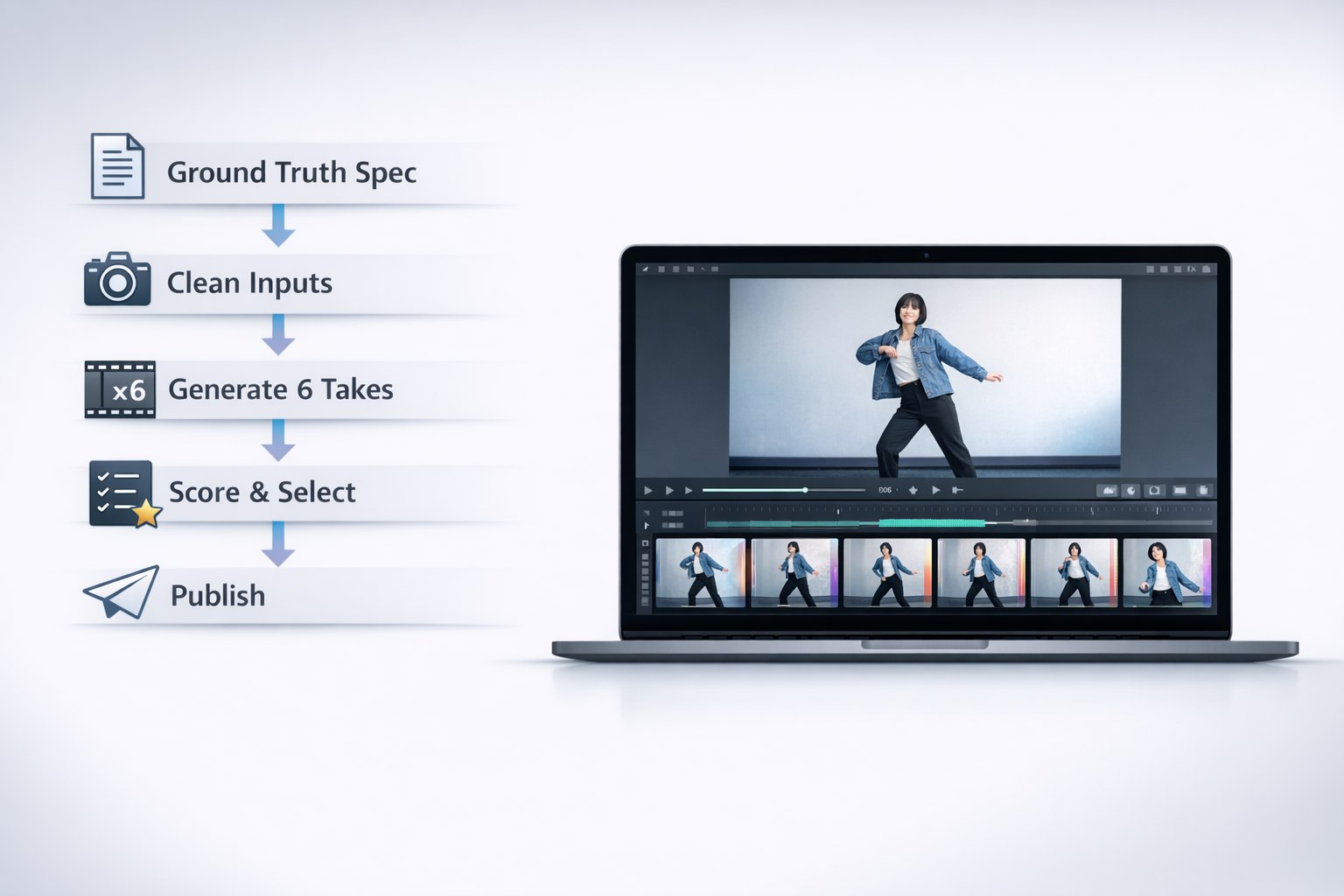
    12. A “one-page” workflow you can reuse every week

    If you want the entire method in a compact form, use this:

    Write a ground-truth spec (goal, anchors, constraints)
    Build a clean input pack (stable framing, clear subject, simple background)
    Generate 6 takes (don’t gamble on 1)
    Score each take (motion, identity, style, camera, publish readiness)
    Troubleshoot with targeted changes (one variable at a time)
    Finish lightly (trim, captions, audio discipline)
    Publish and document what worked (so next week is faster)

    The “documentation” part is what most people skip—and it’s what turns AI video from random outcomes into a dependable production asset.

    13. Optional resources and practice links

    If you’d like a place to practice these steps in a browser-based interface (without changing the tutorial approach), you can explore: GoEnhance AI. Use it as a sandbox to apply the workflow above—especially the input pack, 6-take iteration rule, and scoring rubric.

    14. About this tutorial

    This guide is written as a practical, tool-agnostic production workflow based on common failure patterns in short-form generation and stylization. Results vary by model, settings, and source footage quality. The core principle is stable across tools: reduce ambiguity in inputs, structure prompts consistently, iterate in batches, and evaluate with a rubric so you can ship results instead of chasing perfection.

    Irwin
    MewX LLC
    +1 307-533-7137
    email us here

    Legal Disclaimer:

    EIN Presswire provides this news content “as is” without warranty of any kind. We do not accept any responsibility or liability
    for the accuracy, content, images, videos, licenses, completeness, legality, or reliability of the information contained in this
    article. If you have any complaints or copyright issues related to this article, kindly contact the author above.

  • SimpleDocs Launches the Contract Intelligence Layer

    Policy, Precedent, and Market Standards powered by Law Insider™ Are Now Integrated into Its Award-Winning Microsoft Word Add-In

    The Contract Intelligence Layer gives teams the context behind every negotiation, so they can make decisions faster and with the data they need to defend it.”
    — Preston Clark, CEO, SimpleDocs

    MIAMI, FL, UNITED STATES, February 18, 2026 /EINPresswire.com/ — SimpleDocs today announced the launch of its Contract Intelligence Layer, an advanced benchmarking tool designed to help in-house legal teams make faster contract decisions by integrating internal policies, historical precedent, and verified market standards directly inside Microsoft Word.

    The launch follows a wave of new AI-powered legal tools, including recent contract workflow releases from general-purpose platforms such as Claude. These tools have all made it dramatically easier to analyze contracts, apply instructions, and generate redlines.

    But they all lack the data required to make informed contextual negotiation and drafting decisions.

    Contract Decisions Require More Than AI Reasoning
    AI tools are increasingly good at answering the question: “Given these instructions, what should I say?”

    In-house legal teams, however, are accountable for a harder question: “What does this mean in the context of our policies, our past decisions, and comparable deals in the market?”

    That question cannot be answered by general purpose legal AI tools. It requires decision-grade context.

    “Legal teams don’t need more AI recommendations. They need data-informed decisions,” said Preston Clark, CEO at SimpleDocs. “The Contract Intelligence Layer gives teams the context behind every negotiation, so they can make decisions faster and with the data they need to defend it.”

    Introducing the Contract Intelligence Layer
    The Contract Intelligence Layer unifies the three sources of information legal teams actually rely on when making decisions, but have never had in one place:
    – Policy Data: What the organization has formally approved, including playbook positions, fallbacks, and escalation thresholds.
    – Precedent Data: What the organization has actually accepted in past contracts, exposing patterns, exceptions, and variance between policy and reality.
    – Market Standards: How similar terms appear across real, executed agreements in the broader market, providing an external reference point for risk, leverage, and negotiation posture.

    With these layers of context now available inside the SimpleDocs Microsoft Word Add-In, legal teams can move quickly, stay consistent, and negotiate with confidence without relying on tribal knowledge, repeated escalations, or unnecessary rework.

    Law Insider: The Market Standards Layer
    At the core of the Market Standard layer is the Law Insider database, the world’s largest publicly referenceable collection of executed contracts and clauses.

    Over the past 15 years, Law Insider has built a deep layer of contract intelligence by collecting and analyzing millions of publicly available agreements from around the world. Contract language is parsed into structured data that reveals which clauses are standard for a given agreement, where provisions are commonly missing, how terms vary across industries and jurisdictions, and what language tends to be fair, aggressive, or imbalanced. Spanning more than 40 languages, this dataset represents one of the most comprehensive views of how contracts are actually written and negotiated in the market today – and now serves as a core foundation of the Contract Intelligence Layer within SimpleDocs.

    This is not synthetic data. This is not model inference. This is referenceable “see source” context to accelerate decision making and improve legal judgement.
    – Millions of real agreements (and thousands more added weekly);
    – Organized across industries, jurisdictions, deal sizes, time, and language; and
    – With negotiated outcomes, not “aspirational” templates.

    No general-purpose or legal AI platform has ever integrated this level of market data into the negotiation and drafting process.

    The Contract Intelligence Layer is available today in limited Beta release as part of the SimpleAI Pro package. To request access, join the waitlist here: simpledocs.com/waitlist

    About SimpleDocs

    SimpleDocs is an AI-native contract automation platform built for in-house legal teams and law firms. The platform combines AI-powered drafting, redlining, and review with configurable playbooks and an AI-first contract repository, enabling legal teams to manage contracts from first draft to negotiation and storage. By combining advanced AI with proprietary market data, customer policies and negotiation precedent, SimpleDocs enables faster, more consistent, and more defensible contract decisions— delivering measurable ROI and confidence across every stage of the contracting lifecycle. Explore the future of AI-powered contracts with SimpleDocs at www.simpledocs.com

    Dory Lord
    SimpleDocs
    hello@simpledocs.com

    Legal Disclaimer:

    EIN Presswire provides this news content “as is” without warranty of any kind. We do not accept any responsibility or liability
    for the accuracy, content, images, videos, licenses, completeness, legality, or reliability of the information contained in this
    article. If you have any complaints or copyright issues related to this article, kindly contact the author above.

  • The Functionary Named to CRN’s MSP 500 List For 2026

    Recognition reflects shifting economics and AI-driven transformation inside the MSP market

    We operate inside our MSP partners’ systems as an extension of their teams. That structure protects performance as they scale.”
    — Sam Darwish

    DALLAS, TX, UNITED STATES, February 18, 2026 /EINPresswire.com/ — The Functionary announced today that it has been named by CRN®, a brand of The Channel Company, to the Managed Service Provider (MSP) 500 list in the Pioneer 250 category for 2026. The Functionary is a global outsourcing and technology solutions provider supporting customer service operations, IT help desks, software development, and artificial intelligence (AI) automation inside MSP and technology service delivery environments.

    CRN’s annual MSP 500 list recognizes leading managed service providers in North America. The Pioneer 250 category highlights MSPs focused on serving small and midsize businesses with innovative and reliable service models.

    The Functionary was recognized for enhancing managed service delivery through embedded, white-label operational models that integrate directly into MSP environments. The company provides:

    • Tier 1 and Tier 2 help desk support within client ITSM systems
    • NOC and operational back-end reinforcement
    • Multilingual global coverage
    • AI-assisted workflow optimization and quality oversight
    • Flexible capacity models that protect SLA performance and margin

    “Our MSP partners are managing multiple customized client environments under strict SLAs,” said Sam Darwish, Founder and CEO of The Functionary. “They need stability in their support models, predictable coverage across languages and time zones, and AI adoption without operational disruption. We operate inside their systems, under their governance, as an extension of their teams. That structure protects performance as they grow.”

    Operating as a channel-aligned infrastructure partner, The Functionary integrates into MSP governance frameworks with dedicated teams and clearly defined operational boundaries. This model enables partners to scale SMB and midmarket portfolios while maintaining service consistency, confidentiality, and cost discipline.

    For MSP leaders navigating AI rollout and capacity pressure in 2026, The Functionary recently published an analysis following Microsoft Ignite 2025 outlining key operational considerations: AI Adoption for MSPs: What Service Delivery Leaders Need to Know After Ignite 2025

    About the Functionary
    The Functionary is a global outsourcing and technology solutions provider supporting customer service operations, software engineering, and artificial intelligence (AI) automation for clients worldwide. The company delivers customized services across more than 19 countries through nine delivery hubs, employs almost 2,000 people globally, and maintains 97% SLA delivery and 98% client retention. Recognized on the 2025 Inc. 5000 list for the third consecutive year and named a 2025 Bronze Stevie Award winner for Fastest Growing Company, The Functionary partners with organizations including Amazon, McGraw Hill, Gallo, SimplePractice, Sony, Connection, CSC, Insight, Denali Advanced Integration, and Scale Computing.

    About The Channel Company
    The Channel Company (TCC) is the global leader in channel growth for the world’s top technology brands. We accelerate success across strategic channels for tech vendors, solution providers and end users with premier media brands, integrated marketing and event services, strategic consulting, and exclusive market and audience insights. TCC is a portfolio company of investment funds managed by EagleTree Capital, a New York City-based private equity firm. For more information, visit thechannelco.com.

    © 2026 The Channel Company, Inc. CRN is a registered trademark of The Channel Company, Inc. All rights reserved.

    Heather Peyton
    The Functionary
    heather.peyton@thefunctionary.com
    Visit us on social media:
    LinkedIn
    Instagram
    Facebook

    Legal Disclaimer:

    EIN Presswire provides this news content “as is” without warranty of any kind. We do not accept any responsibility or liability
    for the accuracy, content, images, videos, licenses, completeness, legality, or reliability of the information contained in this
    article. If you have any complaints or copyright issues related to this article, kindly contact the author above.

  • Lumea’s IMS Viewer+™ Achieves CE Marking Under IVDR, Expanding Clinical Use Across Europe

    Lumea’s Viewer+™ software is now CE marked under IVDR for clinical use across Europe, making Lumea the most versatile diagnostic hub for the global market.

    LEHI, UT, UNITED STATES, February 18, 2026 /EINPresswire.com/ — Lumea’s Viewer+™ software is now CE marked under IVDR for clinical use across Europe, making Lumea the most versatile browser-based diagnostic hub for the global market.

    Precision in medicine is a necessity. Pathology data informs nearly 70% of medical decisions, yet diagnostic quality is often hindered (or compromised) by a combination of inconsistencies in tissue handling and siloed digital tools. Lumea’s holistic workflow solutions and Viewer+ address these challenges by providing an optimized and unified path from tissue collection to diagnosis that ensures both precision and efficiency.

    As European laboratories navigate the transition from IVDD compliance to the new In Vitro Diagnostic Regulation (IVDR) requirements, many face a “compliance cliff,” where legacy software and in-house developed tools don’t meet the new, more stringent requirements for clinical use. Lumea’s IVDR-cleared Viewer+ provides a safe harbor for these institutions, offering a globally validated platform that ensures uninterrupted diagnostic services and full regulatory compliance.

    Chelsea Sowards, Chief Commercial Officer at Lumea, commented, “CE marking for Viewer+ enables Lumea to accelerate international growth and extend our digital pathology platform beyond the U.S. This milestone ensures European customers can confidently adopt our technology and realize efficiency, quality, and workflow benefits today.”

    With CE marking under IVDR, Viewer+™ sets a new standard in global digital pathology, offering a robust suite of tools tailored to the modern pathologist’s needs, including:

    – Highest Quality Whole Slide Images: Digital slide images are rendered with precision so high that they are visually equivalent to traditional microscope views.
    – Comprehensive Case Management: Pathologists can manage slide orders, review gross images, access patient history, and track previous biopsy results—all in one place.
    – Integrated Tools: All essential tools are built directly into the viewer, eliminating the need for multiple screens and manual test ordering.
    – Instant Second Opinions: Pathologists can consult peers within and outside their network instantly, ensuring confident diagnoses.

    Designed with efficiency and usability in mind, Viewer+ enables pathologists to sign out cases up to 50% faster while keeping the whole slide image always in view.

    By combining regulatory rigor with an intuitive, high-performance diagnostic technology, Lumea ensures that laboratories can meet today’s demands while preparing for tomorrow’s innovations. This milestone reinforces Lumea’s commitment to empowering pathologists and improving patient outcomes worldwide.

    About Lumea
    Lumea is powering efficient, affordable, and accessible digital pathology through simplified, workflow-driven innovation with both tissue-handling technology and a best-in-class viewer with AI-driven workflows. As the U.S. leader in primary clinical digital pathology, processing the highest volume of digital cases nationwide, Lumea has set the standard for efficiency, quality, and premium cancer diagnostics. With a global presence spanning five continents, Lumea supports over half of the U.S. urology market and top dermatology and gastroenterology groups, optimizing tissue integrity, boosting detection rates, and delivering measurable ROI. By placing patients at the core, Lumea is transforming pathology for a more precise and efficient future. Learn more at lumeadigital.com.

    About CE Marking Under IVDR
    CE marking indicates that an in vitro diagnostic (IVD) device complies with the mandatory European In Vitro Diagnostic Regulation requirements, and that the device can be legally commercialized in the EU. The IVDR went into effect in May 2022, replacing the previous In Vitro Diagnostic Medical Devices Directive (IVDD). These new standards demand enhanced safety, performance, and technical documentation requirements that modernize and improve the reliability of diagnostic tests in the EU. For more information, see https://health.ec.europa.eu/medical-devices-sector/new-regulations_en.

    Bianca Collings
    Lumea
    email us here
    Visit us on social media:
    LinkedIn
    Instagram
    YouTube
    X

    Legal Disclaimer:

    EIN Presswire provides this news content “as is” without warranty of any kind. We do not accept any responsibility or liability
    for the accuracy, content, images, videos, licenses, completeness, legality, or reliability of the information contained in this
    article. If you have any complaints or copyright issues related to this article, kindly contact the author above.

  • Chicago Brand Forecast: Agency Identifies Key Identity Trends Defining the 2026 Market

    Chicago brands are now focusing on clarity and technical precision. The goal is to demonstrate expertise through a refined visual language.”
    — Rufat Mammadyarov, Director of Production

    CHICAGO, IL, UNITED STATES, February 18, 2026 /EINPresswire.com/ — Blacksmith Agency, a national leader in digital strategy and creative design, has reported that Chicago-based companies are increasingly moving away from legacy marketing styles in favor of modern, high-authority branding that aligns with the city’s growing status as a global tech and financial center.

    According to the agency’s data, firms that fail to modernize their visual presence risk stagnating as the market trends towards Midwestern modernism. The Blacksmith Agency outlines four key trends for the Chicago market:

    1. The Rise of Functional Authority: Successful Chicago firms are stripping away decorative elements in favor of bold, utilitarian design. By partnering with a specialized Chicago Branding Agency, local companies are creating a look that prioritizes ease of use and professional trust.

    2. Cross-Platform Visual Consistency: As users move seamlessly between desktop and mobile, Chicago businesses are investing in modular identities that maintain high recognition regardless of the screen size.

    3. Integration of Local Heritage: Blacksmith notes a trend where Chicago firms are subtly incorporating elements into their brand identity that allow them to honor their local roots while maintaining a sophisticated global appeal.

    4. Website Accessibility as a Brand Standard: Beyond simple compliance, the report finds that Chicago’s leading brands are treating accessibility as a core design pillar, ensuring their digital identities are inclusive for all user demographics from the ground up.

    Blacksmith Agency concludes that the 2026 Chicago market will be dominated by brands that can visually communicate reliability and innovation simultaneously.

    About Blacksmith Agency
    Blacksmith Agency is an award-winning digital marketing agency dedicated to forging standout digital identities. Specializing in expert web design, end-to-end SEO, and strategic branding, Blacksmith serves clients across the U.S., helping companies in major metropolitan hubs build authority through world-class creative work.

    Strahil Ovcharov
    Blacksmith Agency
    +1 480-378-2636
    email us here

    Legal Disclaimer:

    EIN Presswire provides this news content “as is” without warranty of any kind. We do not accept any responsibility or liability
    for the accuracy, content, images, videos, licenses, completeness, legality, or reliability of the information contained in this
    article. If you have any complaints or copyright issues related to this article, kindly contact the author above.
  • Click2Mail Partners with Keragon to Offer HIPAA-Compliant Mail Automation for Healthcare Providers

    Partnership allows healthcare organizations to automate mail by connecting Click2Mail to healthcare applications via Keragon’s no-code HIPAA-compliant platform.

    By automating mail fulfillment, we are not only helping them save time and reduce errors but also providing a secure, reliable, and HIPAA-compliant solution that the industry has needed for years.”
    — Lee Garvey, CEO

    ARLINGTON, VA, UNITED STATES, February 18, 2026 /EINPresswire.com/ — Click2Mail, a leader in cloud-based print-to-mail services, today announced a strategic partnership with Keragon, a HIPAA-compliant automation platform for healthcare. This integration empowers healthcare organizations to automate the sending of physical mail, such as letters and postcards, directly from their existing systems, streamlining workflows and enhancing patient communication.

    In the healthcare industry, physical mail remains a critical component of patient outreach, billing, and compliance. However, manual mail processes are often time-consuming, prone to error, and a drain on administrative resources. The Click2Mail-Keragon integration addresses this challenge by connecting Click2Mail with hundreds of healthcare applications, including Electronic Health Records (EHRs), CRMs, and billing platforms.

    “Our partnership with Keragon is a game-changer for our healthcare clients,” said Lee Garvey, CEO of Click2Mail. “By automating mail fulfillment, we are not only helping them save time and reduce errors but also providing a secure, reliable, and HIPAA-compliant solution that the industry has needed for years. This is about transforming a manual task into a seamless, automated part of their daily operations.”

    The integration allows healthcare teams to set up “no-code” automations that trigger the sending of physical mail based on specific events. For example, a billing statement can be automatically mailed when a new invoice is generated, or a welcome packet can be sent when a new patient is registered.

    “We are excited to partner with Click2Mail to extend the power of automation to physical mail,” said Conno Christou, CEO of Keragon. “Healthcare teams can now have confidence that their important communications are being sent consistently and on time, without the manual effort. This allows them to focus on what matters most: patient care.”

    Key benefits of the Click2Mail-Keragon integration include:
    * Automated Workflows: Eliminates the need for manual data entry and file uploads.
    * Improved Compliance: Keragon is HIPAA-compliant and SOC2 Type II certified, and all plans include a Business Associate Agreement (BAA).
    * Increased Efficiency: Reduces staff workload and minimizes the risk of errors.
    * Enhanced Patient Communication: Ensures timely and consistent delivery of important notices and outreach materials.

    About Click2Mail:
    Click2Mail is a cloud-based platform that makes it easy and affordable to send postal mail. With a suite of applications, tools and a powerful API, Click2Mail helps thousands of businesses automate their mailings and eliminate the hassle of printing and postage.

    About Keragon:
    Keragon is a HIPAA-compliant automation platform that empowers healthcare teams to create their own automated workflows without any coding. By connecting with hundreds of healthcare apps, Keragon helps streamline processes, reduce administrative tasks, and improve patient care.

    Carly Brown
    Click2Mail
    +1 866-665-2787
    email us here
    Visit us on social media:
    LinkedIn
    Facebook
    YouTube

    Legal Disclaimer:

    EIN Presswire provides this news content “as is” without warranty of any kind. We do not accept any responsibility or liability
    for the accuracy, content, images, videos, licenses, completeness, legality, or reliability of the information contained in this
    article. If you have any complaints or copyright issues related to this article, kindly contact the author above.